AskIndra: Turning Environmental Data into Everyday Decisions
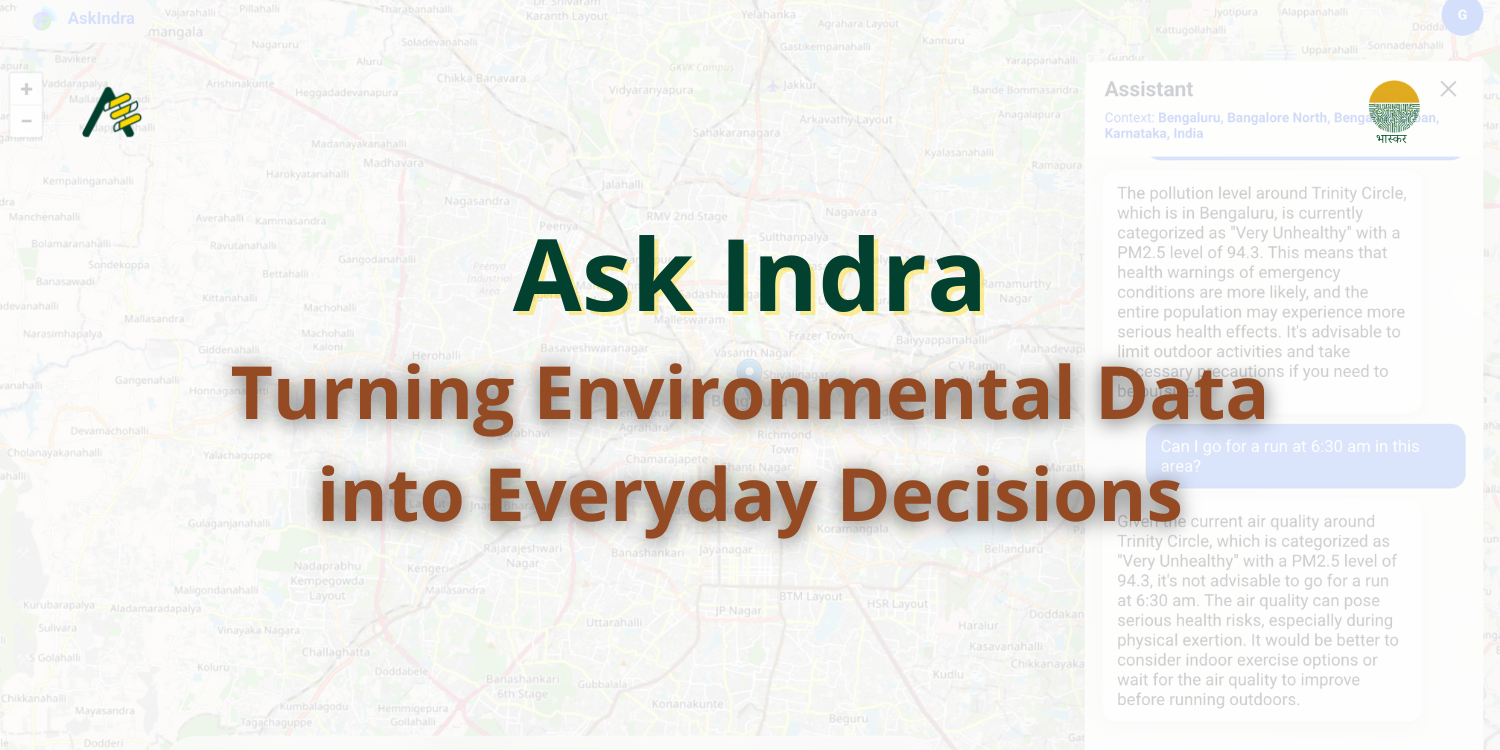

At 8:30 in the morning, a familiar ritual unfolds. Shoes on, phone in hand, a quick glance at the weather and air quality before stepping outside. One app reports “Moderate” air quality. Another shows a number that feels important but unclear. A notification appears and disappears with a swipe. The questions remain unanswered: mask or no mask, walk now or later, windows open or shut. The data is abundant, yet the decision still feels uncertain.
AskIndra exists for this moment.
Emerging as one of the first projects from Bhaskar Labs, AskIndra represents a new direction in how environmental intelligence is designed and delivered. Bhaskar Labs is a newly launched innovation space dedicated to supporting the growth of Indic AI and culture-tech projects - systems that are rooted in local contexts, lived realities, and everyday decision-making rather than abstract dashboards. AskIndra reflects this philosophy by focusing on interpretation, relevance, and usability rather than raw data exposure.
The Environmental Information Gap
Over the last decade, access to environmental data has expanded dramatically. Weather forecasts, air quality indices, UV levels, pollen counts, and heat alerts update continuously across dozens of platforms. Yet greater access has not necessarily translated into better understanding.
Most tools are designed to display measurements, not to support decisions. Numeric indices arrive without explanation. Labels such as “moderate” or “acceptable” provide little clarity about personal impact. Alerts often fail to explain who is at risk or what action makes sense in a given situation.
Research reflects this gap. Studies on air-quality communication show that neutral descriptors can reduce perceived risk and lower precautionary behaviour, particularly when messaging lacks specificity. The World Health Organisation has similarly highlighted how inconsistent air-quality indices across regions make it difficult for people to interpret health implications or adjust behaviour meaningfully.
The result is a paradox: environmental information is everywhere, yet decision-making remains uncertain. Data without context becomes cognitive noise, something people scroll past rather than act on.
A Different Approach to Environmental Intelligence
AskIndra approaches this challenge from a fundamentally different starting point. Instead of asking users to interpret data, it focuses on translating environmental conditions into guidance that fits naturally into daily life.
Built as a conversational interface, AskIndra allows users to engage with their environment through questions they already think in:
🌀 Is it safe to walk outside right now?
🌀 Should I exercise outdoors today?
🌀 Do I need to take precautions during my commute?
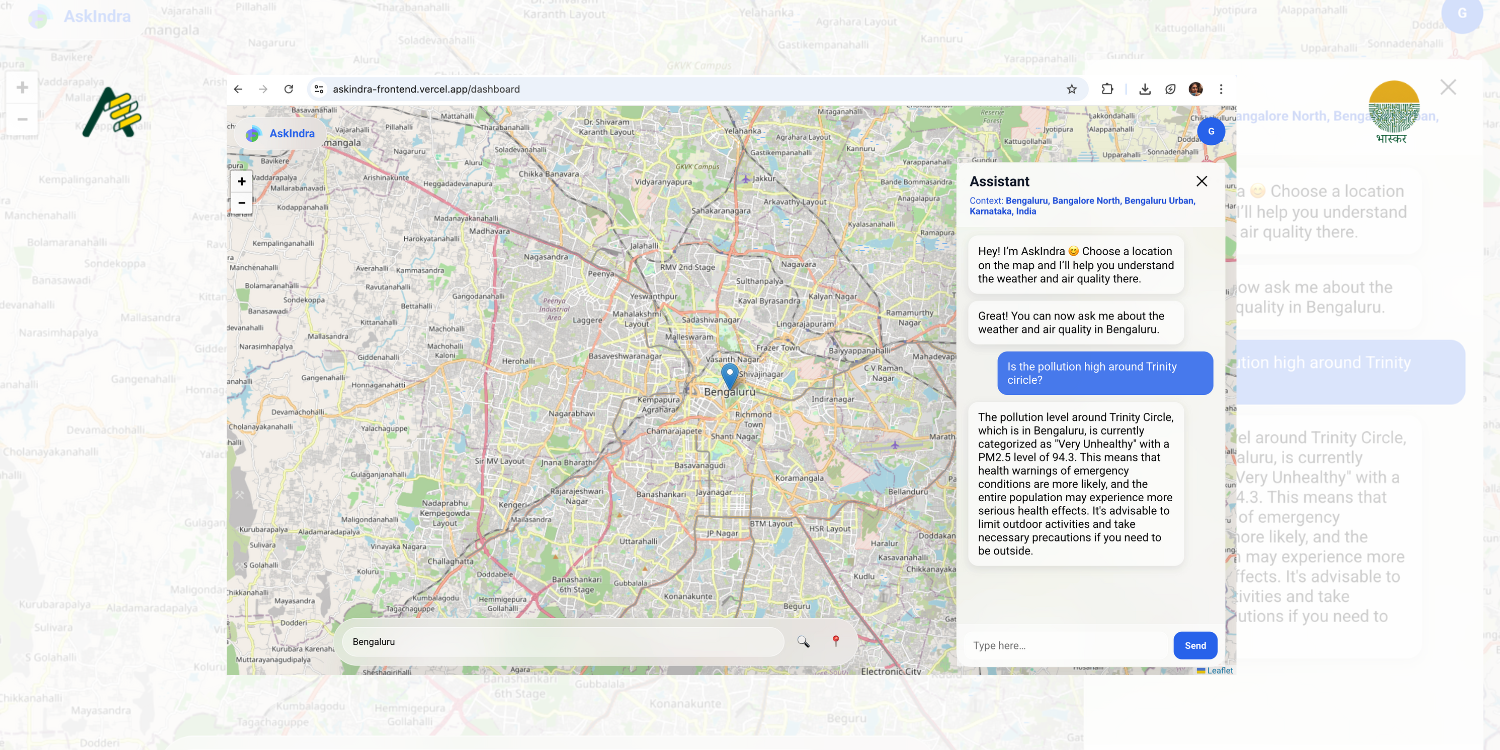
Behind each response is real-time environmental data (air quality readings, weather forecasts, pollution levels) interpreted and contextualised to the user’s location and situation. The emphasis is on clarity, relevance, and action rather than technical precision alone.
This design choice reflects a broader principle emerging from Bhaskar Labs: technology should adapt to people, not require people to adapt to technology.
From Dashboards to Dialogue
Environmental dashboards assume a level of expertise most users do not have the time or inclination to develop. AskIndra replaces this model with dialogue. Users do not need to understand AQI scales, pollutant thresholds, or forecast models. They ask questions in plain language and receive responses that are:
🌀 Easy to understand, without technical jargon
🌀 Grounded in verified data from trusted sources
🌀 Actionable, offering clear next steps or precautions
By reducing cognitive load, AskIndra enables informed decisions without turning environmental awareness into an analytical task. Over time, the system can adapt to user preferences, routines, and sensitivities, making guidance increasingly relevant and personal while remaining transparent and data-driven.
Reliability by Design
Trust is central to AskIndra’s design. The platform continuously ingests data from established air-quality and weather providers and normalises different standards into a consistent internal representation. Its AI layer interprets data rather than fabricating it, ensuring recommendations remain traceable and grounded.
Equally important is data responsibility. AskIndra follows a minimal-collection approach, encrypts all user data, anonymises aggregated insights, and keeps recommendations advisory rather than prescriptive. Users retain control over how their information is used.
Who AskIndra Serves
AskIndra is designed for people whose daily lives are shaped by environmental conditions:
🌀 Individuals managing asthma, allergies, or respiratory sensitivities
🌀 Urban commuters navigating fluctuating air quality and heat
🌀 Outdoor runners, walkers, and cyclists planning safe activity windows
🌀 Organisations seeking to protect employee health
🌀 Researchers and policymakers looking for interpretable environmental insights
The common thread is a need for clarity without complexity.
Looking Ahead
As AskIndra evolves, its focus extends beyond real-time awareness toward anticipation. Future directions include pollution forecasting, deeper personalisation, integration with wearables and smart environments, and community-level insights that help neighbourhoods understand shared risks.
As one of the first initiatives from Bhaskar Labs, AskIndra signals a larger ambition: building Indic AI systems that are locally grounded, ethically designed, and culturally attuned to everyday life.
Making the Invisible Understandable
Environmental conditions influence health, energy, and safety in subtle but persistent ways. AskIndra brings those forces into focus through interpretation rather than overload. By turning complex data into clear everyday guidance, it supports more confident decisions and a more informed relationship with the environment.
To explore the thinking, research, and design principles behind AskIndra in greater depth, read the AskIndra White Paper. The paper details the communication challenges in environmental intelligence, the system architecture behind AskIndra, and the broader vision guiding Bhaskar Labs’ work in Indic AI and culture technology.
Interested in collaborating, researching, or building with us?
Bhaskar Labs is actively exploring partnerships across AI research, public health, climate, culture-tech, and policy. Reach out on hello@adaptiv.me to connect and shape the next generation of human-centred environmental intelligence together.
