Chhaon (छाँव): Shade as Infrastructure
Adaptiv Founder
May 21, 2026 · 7 min read

There is a Hindi word, छाँव (chhaon) that means shade. Not the abstract kind, but the specific, physical relief of stepping out of the sun into the cool beneath a tree. Anyone who has spent a summer in Rajasthan knows that this is not a small thing. It is the difference between bearable and unbearable, between a city that sustains life and one that merely endures it.
Bhaskar's latest project through Adaptiv is named exactly that - Chhaon - and it arrives in Ajmer in 2026 as something genuinely difficult to categorise. Part café, part library, part living forest experiment, it is the most serious attempt yet to answer a question that Indian cities have been avoiding for decades: what does it actually feel like to fix the urban heat problem, and can a city be convinced to want that fix?
The Numbers Behind the Heat
To understand why Chhaon matters, you have to understand what is happening to Indian cities - and to the planet.
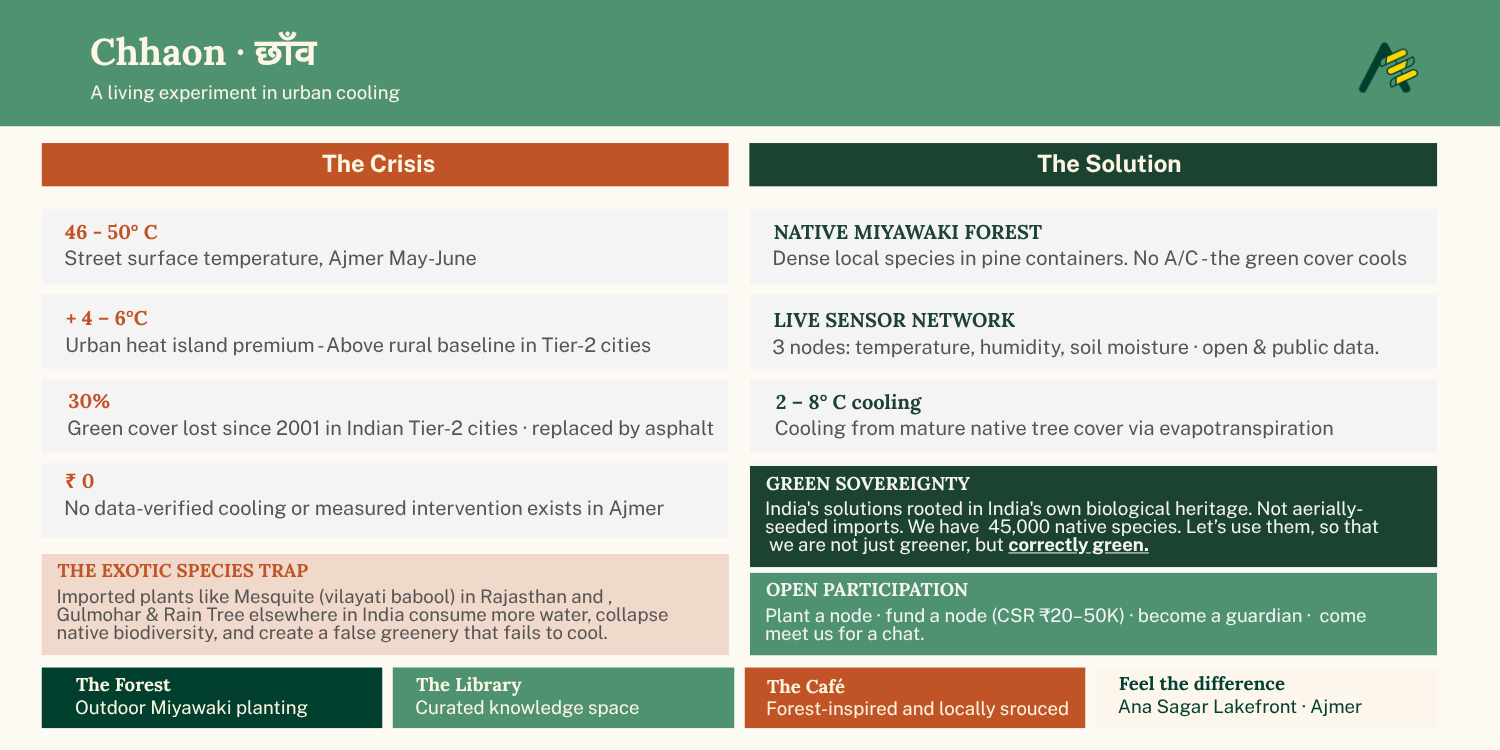
Global average temperatures have risen by approximately 1.2°C above pre-industrial levels, but this headline figure obscures how unevenly that heat is distributed. Cities absorb and retain heat far more aggressively than surrounding rural areas — a phenomenon called the urban heat island effect — and in India's Tier-2 cities, this premium can reach 4 to 6 degrees Celsius above the rural baseline. In practical terms, when Ajmer's streets record 46 to 50°C surface temperatures in May and June, they are not reflecting a natural ceiling. They are reflecting a policy failure compounded over decades.
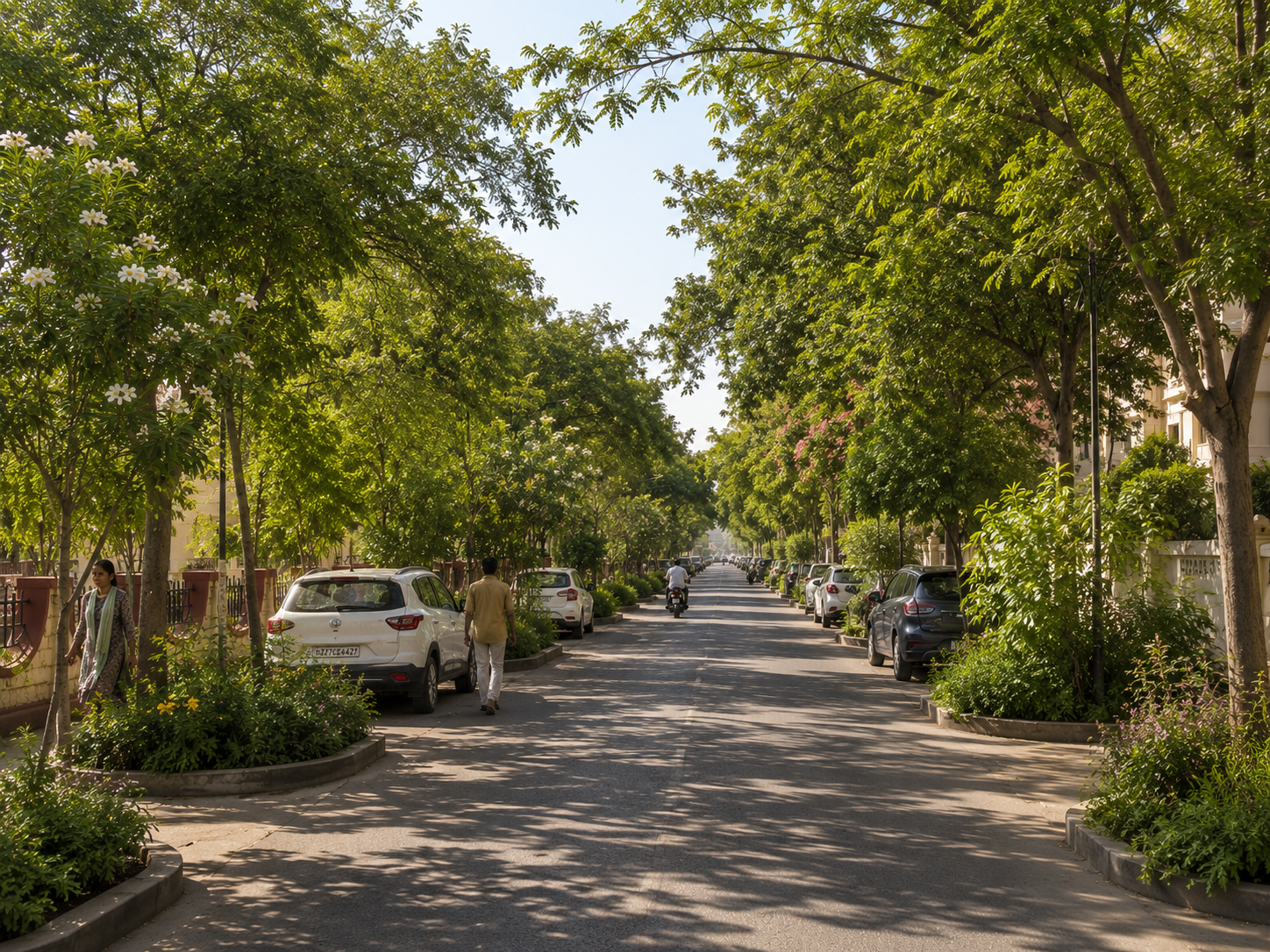
India has lost significant green cover across its urban areas - Tier-2 cities alone have shed roughly 30% of their tree canopy since 2001. Trees are not decorative. A mature tree can reduce surrounding air temperature by 2 to 8°C through evapotranspiration, intercept rainfall, recharge groundwater, and provide habitat for native insects and birds. When they disappear from urban streets, they are replaced by asphalt and concrete that absorb heat during the day and release it at night, keeping cities hot around the clock.
The water crisis compounds this directly. Rajasthan is one of India's most water-stressed states, and Ajmer's relationship with water has always been precarious. The Ana Sagar Lake, beside which Chhaon will be located, has in recent decades suffered from falling water levels, encroachment, and degraded ecological health - a mirror of what is happening to water bodies across the country. As urban heat rises, evaporation accelerates, groundwater recharge declines, and the communities least insulated from these effects (vendors, labourers, children, the elderly) bear the heaviest cost.
What Chhaon Actually Is
Chhaon is, at first glance, a café beside the Ana Sagar Lakefront. But the deck that introduces the project offers a more precise description: "This is not a café with plants. It is a climate experiment you can sit inside of."
The space is organised into three interlocking zones.
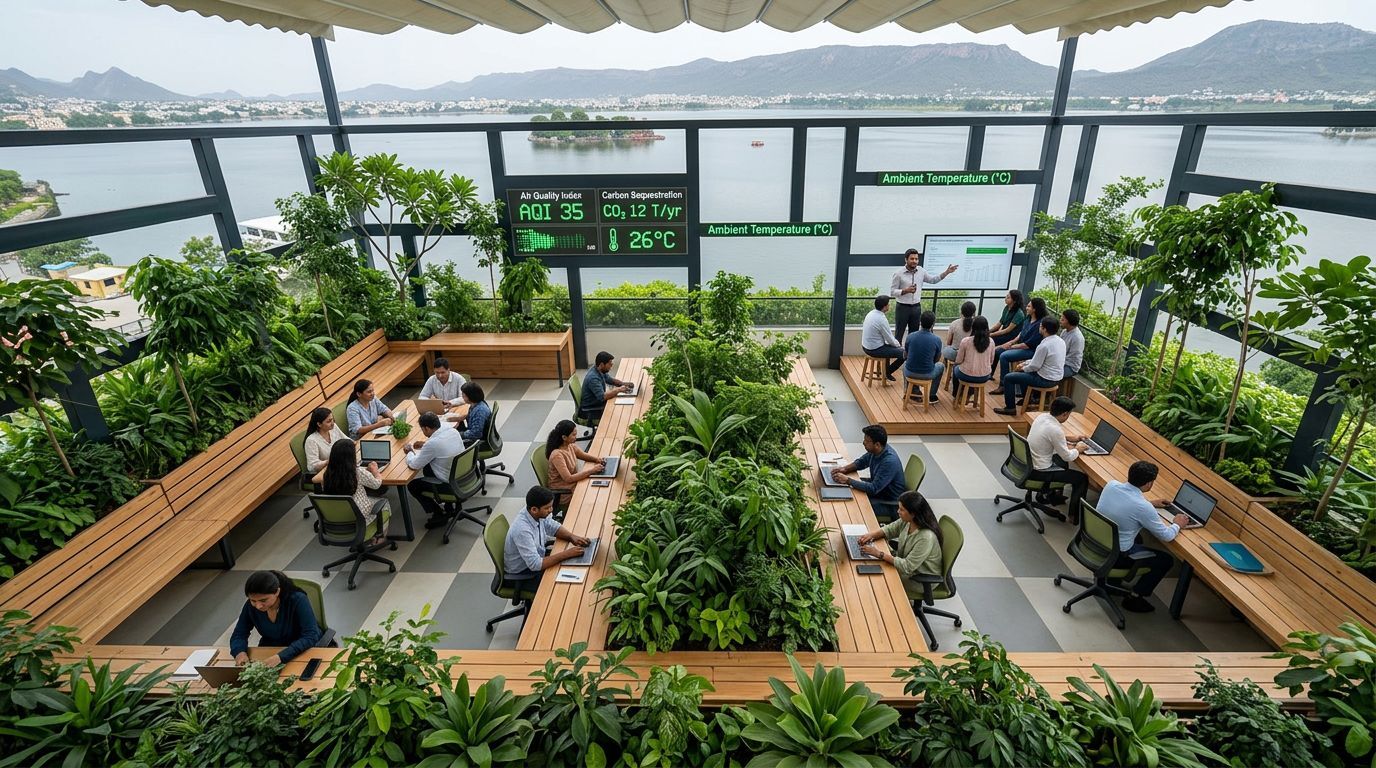
The Forest is an outdoor Miyawaki planting - a Japanese-derived method of creating dense, fast-growing native forests in compact spaces, using layered species that accelerate ecological succession. Crucially, Chhaon uses only native species, grown in pine containers with live sensor nodes measuring temperature, humidity, and soil moisture in real time. Every planter carries a QR code linking visitors to live data. You are not walking through a garden. You are walking through a working dataset.
The Café draws its inspiration entirely from what grows in region- a forest-inspired café in the most literal sense. There is no air conditioning. The forest cools the space instead, and a live display above the counter shows the current temperature inside Chhaon against the temperature on the street outside. The menu, too, is based on season produce and locally sourced ingredients.
The Library completes the experience - a curated reading space, with a green-arched alcove, borrowing membership, and the deliberate intention of being a thinking place rather than a waiting room.
The Case for Native Species — and Why It Matters Nationally
The choice to use exclusively native species is not incidental. It is arguably the most important design decision in the project.
As one of the world's most biodiverse countries, India is home to nearly 45,000 plant species, a significant proportion of which are endemic. Yet greening projects across the country have consistently defaulted to exotic, fast-growing species: Gulmohar (originally from Madagascar), Rain Tree (South America), or invasive varieties that look lush but provide little ecological value. These plants do not support native pollinators, do not integrate with local soil microbiomes, and in many cases consume more water than the species they displaced.
Rajasthan has its own cautionary tale, and it is a stark one. Prosopis juliflora - a thorny shrub native to the Americas was introduced across the state as a deliberate afforestation measure, its seeds aerially scattered from aircraft and its saplings planted along roadsides to "green" the desert. The results have been ecologically disastrous. Rather than restoring dryland ecosystems, the plant has transformed open scrublands and grasslands into impenetrable monoculture thickets, outcompeting native species and collapsing the biodiversity of birds, insects, and indigenous plants that depended on those open habitats. It has altered soil chemistry, disrupted the water table, and created what can only be described as a false greenery - visually convincing, ecologically hollow. Rajasthan looks greener on satellite imagery, but it is functioning less like itself than at any point in recorded history.
This is the trap that Chhaon is explicitly working to refuse. Native plants have co-evolved with local conditions over thousands of years. They are drought-adapted, deeply integrated with local fauna, and require significantly less water once established. In a region already under severe water stress, the distinction between a native and an exotic species is not botanical pedantry - it is the difference between a solution and a substitution.
Chhaon's insistence on native species is also, quietly, a statement about green sovereignty - the idea that India's ecological solutions should be rooted in India's own biological heritage rather than imported templates. As climate anxiety drives greening initiatives across Indian cities, there is a real and present risk that well-intentioned projects repeat the Prosopis mistake at urban scale: homogenising plant life with exotic species, eroding the local knowledge, seed banks, and ecological relationships that have been cultivated over centuries. Chhaon resists this drift - and in doing so, makes an argument that every Indian city planner should be forced to sit with..
Data as Infrastructure
One of Chhaon's most important contributions is our commitment to open, verifiable data. The project notes, pointedly, that there is currently ₹0 worth of data-verified cooling active in Ajmer. This is not a trivial observation. Most urban greening efforts in India operate without baseline measurement, without sensors, and without the ability to prove (or disprove) their own effectiveness. This makes it nearly impossible to scale what works, or to hold poorly designed interventions accountable.
By embedding live sensor nodes throughout the forest and making that data public, Chhaon is creating something rare in the Indian climate tech landscape: a replicable, evidence-based model. The data generated here on temperature differentials, humidity, soil moisture under native plantings in an arid Rajasthani context could inform municipal policy, urban planning curricula, and future interventions across the region.
An Invitation, Not a Statement
Perhaps the most distinctive quality of Chhaon is its tone. The project is explicit that it is not asking Ajmer to watch - it is asking Ajmer to participate. Residents can plant a sensor node on their street or terrace, fund one through CSR contributions (₹20,000–50,000 for full impact data), or become a guardian responsible for watering a single node. The lowest barrier to entry is simply walking in. Learn more here.
This is climate work that meets people where they are - not in a conference room or a policy document, but over a drink, in the shade, in a city that desperately needs both.
Chhaon opens at the Ana Sagar Lakefront, Ajmer, in 2026. Come and feel the difference.
Adaptiv Founder
@adaptivfounder