The 3-Hour AI Workshop Won't Save Your Career
Adaptiv Admin
Sep 16, 2026 · 8 min read

There’s a particular kind of anxiety making its rounds in offices, college campuses, and family WhatsApp groups across India right now. The usual job hunt and career progression anxiety is now coupled with “Am I going to be replaced by AI?”
And in response to that anxiety, a cottage industry has emerged. Weekend workshops. Three-hour bootcamps. Online certificates you can finish before lunch. All promising the same thing: learn AI, stay relevant, future-proof your career.
It’s a comforting idea. It’s also dangerously incomplete.
The Illusion of the Quick Fix
Let’s be honest about what a three-hour AI workshop actually teaches you. You’ll learn how to type a prompt into ChatGPT. You might generate an image, summarise a document, or write an email using an AI tool. You’ll leave feeling informed, maybe even excited.
And then Monday morning arrives. Your job hasn’t changed. The problems your organisation faces haven’t changed. The question of what to really do with AI in your actual work? Still unanswered.
This isn’t a criticism of workshops. Short sessions have their place. The problem is when they’re sold — and worse, when they’re consumed — as sufficient preparation for an AI-driven economy. They aren’t. Not even close.
Here’s why.
AI Is Not a Tool. It’s a System.
We talk about AI the way we used to talk about the internet in the early 2000s — as a feature you add to your life, a skill you tick off a list. But the internet didn’t just give us faster communication. It restructured entire industries, created new ones from nothing, erased others, and fundamentally changed how human beings relate to information, commerce, and each other.
AI is doing the same thing. Faster.
Which means that the question shouldn’t be “do you know how to use an AI tool?”
The question is: do you understand how AI is reshaping the systems — economic, professional, ethical, social — that your life and career are embedded in?
Those are very different questions. And the gap between them is exactly where most short workshops fail.
To survive and thrive in an AI-driven economy, you need to understand AI holistically. That means understanding not just what it can do, but how it works — well enough to direct it intelligently, question its outputs critically, and apply it to problems that actually matter. It means understanding where AI creates leverage and where it creates risk. It means knowing what AI cannot replace, and building those capabilities deliberately.
A three-hour session gives you a surface. What is needed is depth.
The Ethics Question Nobody Asks in Weekend Workshops
Here’s something that almost never comes up in short AI courses: the ethics of what you’re building or using.
AI systems are not neutral. They are trained on data that reflects the world as it has been — with all its biases, inequalities, and blind spots baked in. An AI hiring tool trained on historical data will replicate historical hiring patterns. An AI credit-scoring model will encode existing financial exclusions. An AI content recommendation system will amplify whatever has worked before, for better or for worse.
If you are using AI without understanding this, you are not just an uninformed user. You are a participant in the perpetuation of those patterns.
The professionals who will genuinely lead in an AI-driven economy aren’t those who can use the most tools. They’re the ones who understand enough about how AI works to ask the right questions before deploying it. Whose data trained this model? What assumptions are embedded in its outputs? Who benefits from this, and who might be harmed?
These aren’t abstract philosophical questions. They’re practical career questions. Organisations — especially those operating at scale — are increasingly looking for people who can navigate AI governance, responsible deployment, and ethical use. That’s a skill set. It takes time to build. And it starts with actually understanding how AI works, not just what buttons to press.
What the Job Market Is Actually Asking For
There’s a gap between what most people think employers want from AI-skilled candidates and what employers actually want.
Most people assume: know the tools, get the job.
What forward-thinking employers are actually looking for: people who can think clearly about complex problems, communicate AI-driven insights to non-technical stakeholders, design solutions that work in the real world, and take initiative without waiting for a brief.
In other words: AI capability plus human capability. Together.
The professionals who are genuinely moving ahead in this market aren’t just prompt engineers. They’re people who understand systems — how the pieces of an organisation, a product, or a market connect and influence each other. They’re people who can take an AI output and turn it into a decision, a product, a pitch. They’re people who have actually built something with AI, not just experimented with it.
This is a fundamentally different kind of preparation. And it requires a fundamentally different kind of learning experience.
Why Building Something Changes Everything
There is an enormous difference between knowing how to use an AI tool and knowing how to build a product with AI.
When you build something — a real product, for a real problem, with real constraints — everything becomes concrete. You discover that prompt engineering is a design discipline, not a party trick. You discover that the hardest part of building an AI-powered product isn’t the AI — it’s understanding the problem deeply enough to know what to build. You discover that your communication skills, your ability to think through systems, your creative judgment — these are not soft skills. They are the skills that determine whether your AI-powered product actually works for the people it’s meant to serve.
You also discover what you don’t know. And that discovery — specific, personal, urgent — is what real learning feels like.
A hands-on build experience forces you to develop the complementary skills that every AI professional in the next decade will need: systems thinking, creative problem-solving, user empathy, ethical reasoning, and the ability to communicate technical ideas to a non-technical world. These can’t be taught in a lecture. They can only be developed by doing.
The Shortcut That Isn’t A Shortcut
There’s a tempting logic that says: I’ll just do the short course now, and if I need more, I’ll go deeper later.
The problem with this logic is timing. The AI-driven restructuring of industries is not a slow tide — it’s a fast one. The professionals who will hold the most leverage in the next three to five years are the ones investing seriously in their AI capability right now, not the ones who took a weekend course in 2024 and assumed that was enough.
The certificate from a three-hour workshop will not distinguish you in a competitive job market. What will distinguish you is evidence of real capability: something you built, a problem you solved, a product you shipped.
That kind of evidence takes time to develop. Which is exactly why now is the right moment to start building it properly.
A Different Kind of Programme
At Adaptiv School, we built our programme around a simple premise: AI literacy without application is trivia. What changes careers — and lives — is the combination of deep AI understanding, real product-building experience, and the human skills that make both of those things count.
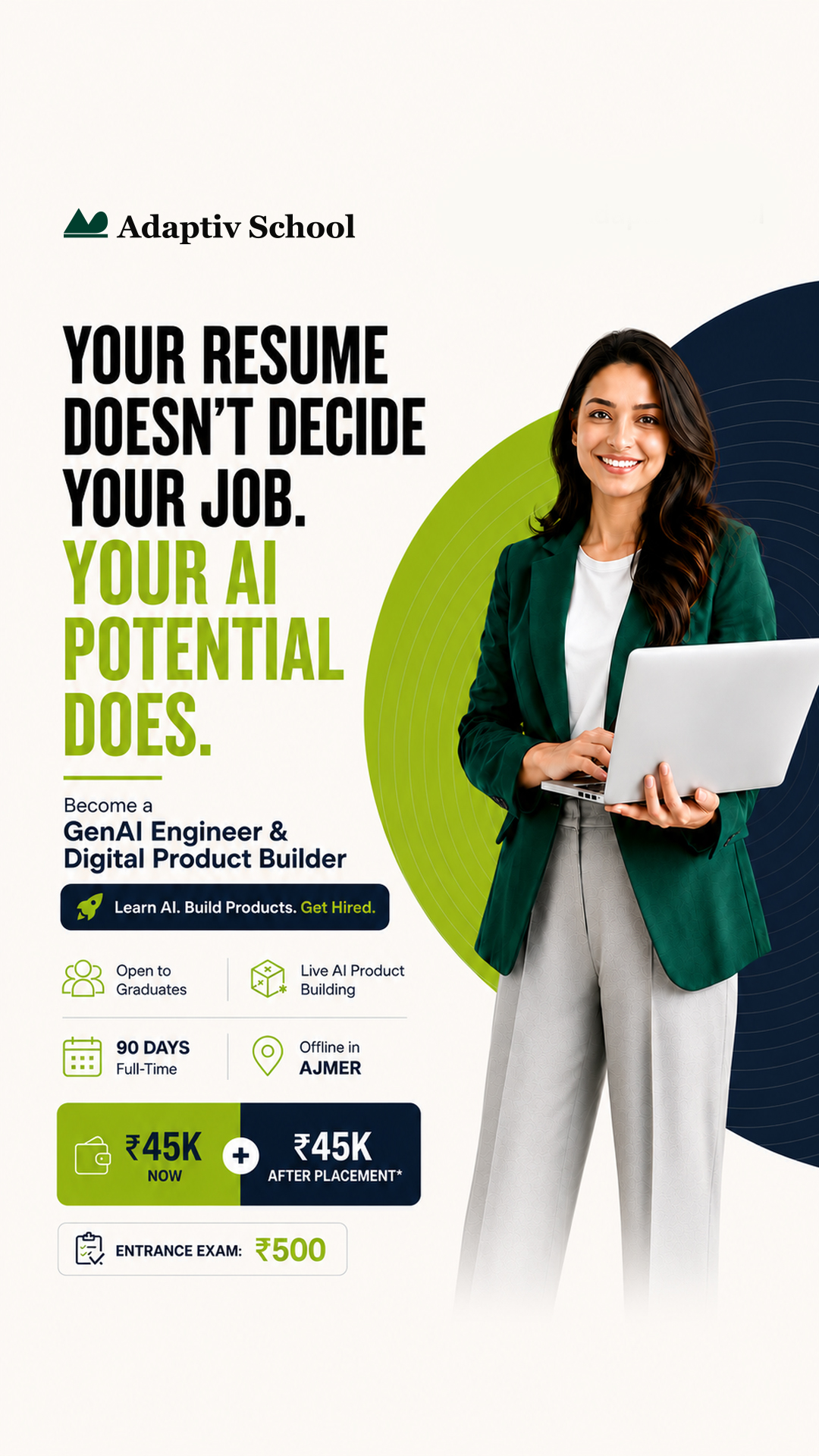
Our 90-day full-time programme in Ajmer is designed for graduates who are ready to stop watching the AI revolution from the sidelines and start participating in it. You’ll learn how AI actually works — well enough to use it ethically, direct it intelligently, and build with it meaningfully. You’ll develop the systems thinking, communication skills, and creative problem-solving capability that employers and the market are genuinely looking for. And you’ll build a real AI product — from problem identification to working demo — that becomes the most credible thing on your CV.
This is not a weekend workshop. It is not a passive online course. It is a full-time, hands-on, live product-building experience that ends with something you made, a pitch you delivered, and a career trajectory that looks fundamentally different from the one you arrived with.
Adaptiv School’s GenAI Engineer & Digital Product Builder programme is now open for applications. 90 days. Full-time. Offline in Ajmer. Fee: ₹45,000 now + ₹45,000 after placement. Entrance exam: ₹500.
Your resume doesn’t decide your job. Your AI potential does.
Adaptiv Admin
@admin
Building the future of AI products at Adaptiv.Me.