The Real Lifecycle of an AI Product
Geetanjali Shrivastava
Mar 4, 2026 · 4 min read
Artificial intelligence products often appear deceptively simple from the outside: A user interacts with a chatbot, recommendation engine, or automation feature, and the underlying system feels seamless. In reality, successful AI products emerge from a complex lifecycle that extends far beyond model training.
Many organisations still approach AI as a research initiative rather than a product discipline. The result is a recurring pattern: promising prototypes that struggle to translate into reliable production systems. Understanding the full lifecycle of AI development helps teams design systems that move from experimentation to sustainable deployment.
Discovery: Identifying the Right Problems
AI initiatives often begin with technology rather than user problems. Teams start with a model capability - classification, generation, prediction - and search for places to apply it.
A more effective approach begins with discovery. This stage examines workflows, decision points, and inefficiencies where machine intelligence could meaningfully assist users. The focus is not on whether a model can technically perform a task, but whether the task improves when assisted by AI.
Discovery work typically includes:
Mapping decision processes and user workflows
Identifying areas with high cognitive load or repetitive analysis
Assessing the availability and reliability of relevant data
Without this groundwork, teams risk building AI features that function technically but provide limited value in practice.
Experience Strategy: Designing Human–AI Interaction
AI systems rarely operate independently. Most are embedded within broader workflows where humans interpret, validate, or refine outputs.
Designing this interaction is a critical stage in the lifecycle. Poorly designed interfaces often undermine otherwise strong models. For example, a recommendation engine that cannot communicate confidence levels or reasoning may create friction rather than efficiency.
Experience strategy addresses questions such as:
When should AI act autonomously versus providing suggestions?
How should uncertainty or confidence be communicated?
What level of transparency do users require to trust the system?
Effective AI products treat model outputs as part of a user experience rather than an isolated technical function.
Model Experimentation: Iterative Learning
Once the problem and experience design are defined, teams can begin model experimentation. At this stage, the objective is not simply to train a model, but to evaluate multiple approaches and understand their trade-offs.
Experimentation typically involves:
Comparing model architectures and training approaches
Evaluating performance across diverse datasets
Stress-testing models under edge cases and unexpected inputs
Metrics during this phase should reflect real-world use cases. A model with strong benchmark scores may still fail when deployed in dynamic environments.
The experimentation phase also reveals an important insight: model accuracy alone rarely determines product success. Latency, reliability, and interpretability often carry equal weight in practical systems.
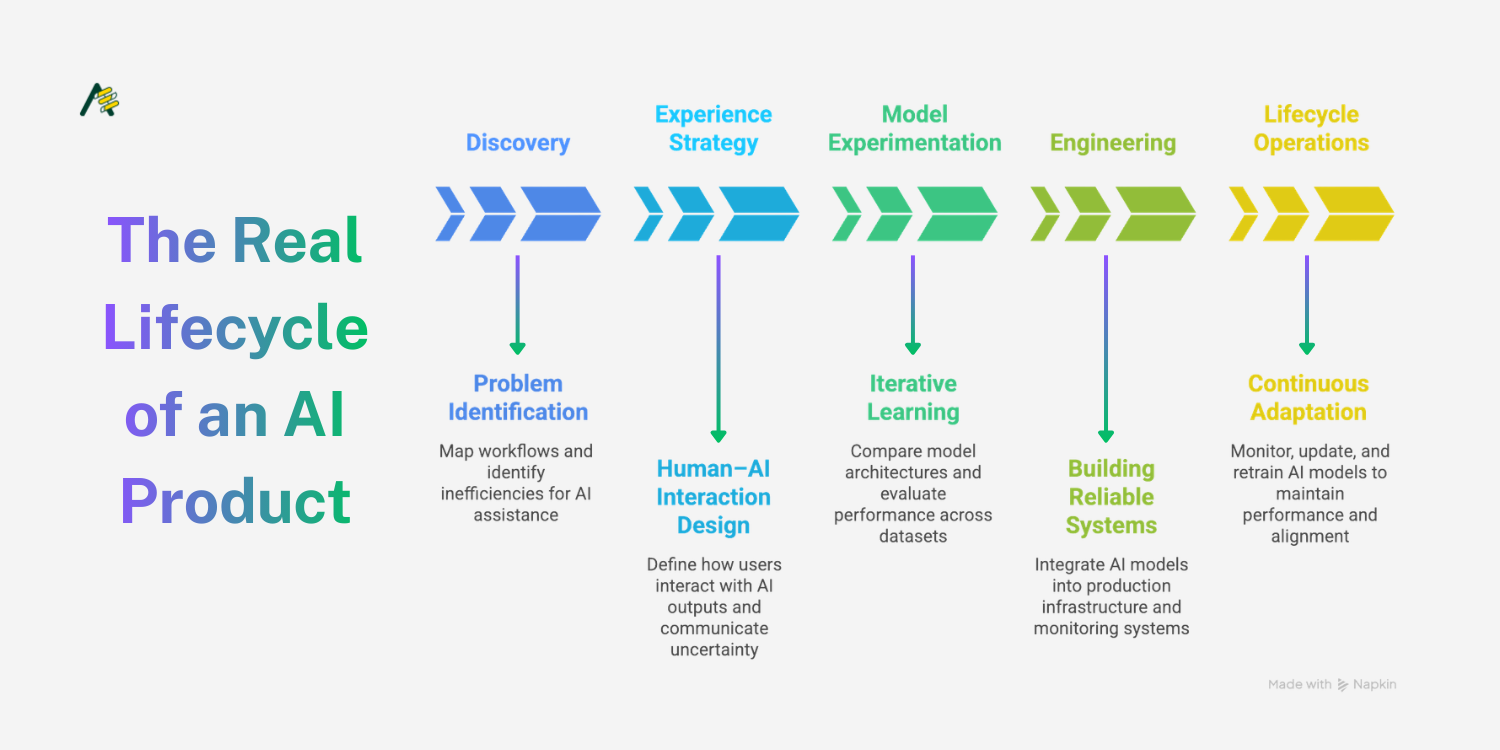
Engineering: Building Reliable Systems
The transition from experimentation to engineering is where many AI projects stall. A model that performs well in controlled experiments must now operate as part of a broader system.
Production engineering introduces additional considerations:
Data pipelines for continuous input streams
Infrastructure capable of scaling inference workloads
Monitoring systems to detect performance drift
Integration with existing software platforms
Engineering decisions influence everything from response times to operational costs. These factors ultimately determine whether an AI feature can operate reliably in real-world environments.
Lifecycle Operations: Continuous Adaptation
Unlike traditional software features, AI systems evolve after deployment. Data distributions shift, user behavior changes, and new edge cases emerge over time.
Lifecycle operations ensure systems remain stable and effective through:
Monitoring model performance and error rates
Updating training data as new patterns appear
Retraining models to maintain accuracy
This phase also introduces governance considerations, particularly when AI systems influence financial, educational, or healthcare decisions.
Organisations that treat AI as static software often encounter gradual degradation in model quality. Continuous evaluation and iteration help maintain alignment between models and real-world conditions.
Integrating the Full Cycle
AI product development requires collaboration across multiple disciplines. Product strategy, design, machine learning, and engineering all influence outcomes at different stages of the lifecycle.
When these stages operate in isolation, progress slows and knowledge fragments across teams. A more integrated approach allows insights from experimentation to inform product design, while operational data shapes future iterations.
The lifecycle perspective encourages teams to treat AI systems as evolving products rather than isolated technical artefacts. With this mindset, organisations can move beyond experimentation and build systems that deliver consistent value over time.
Geetanjali Shrivastava
@geetanjalishrivastava