Case Study: The Choice of Sairandhri (Draupadi’s Hidden Identity) as Central Theme & Protagonist of an AI Film
Adaptiv Admin
Apr 11, 2026 · 13 min read
Executive Summary
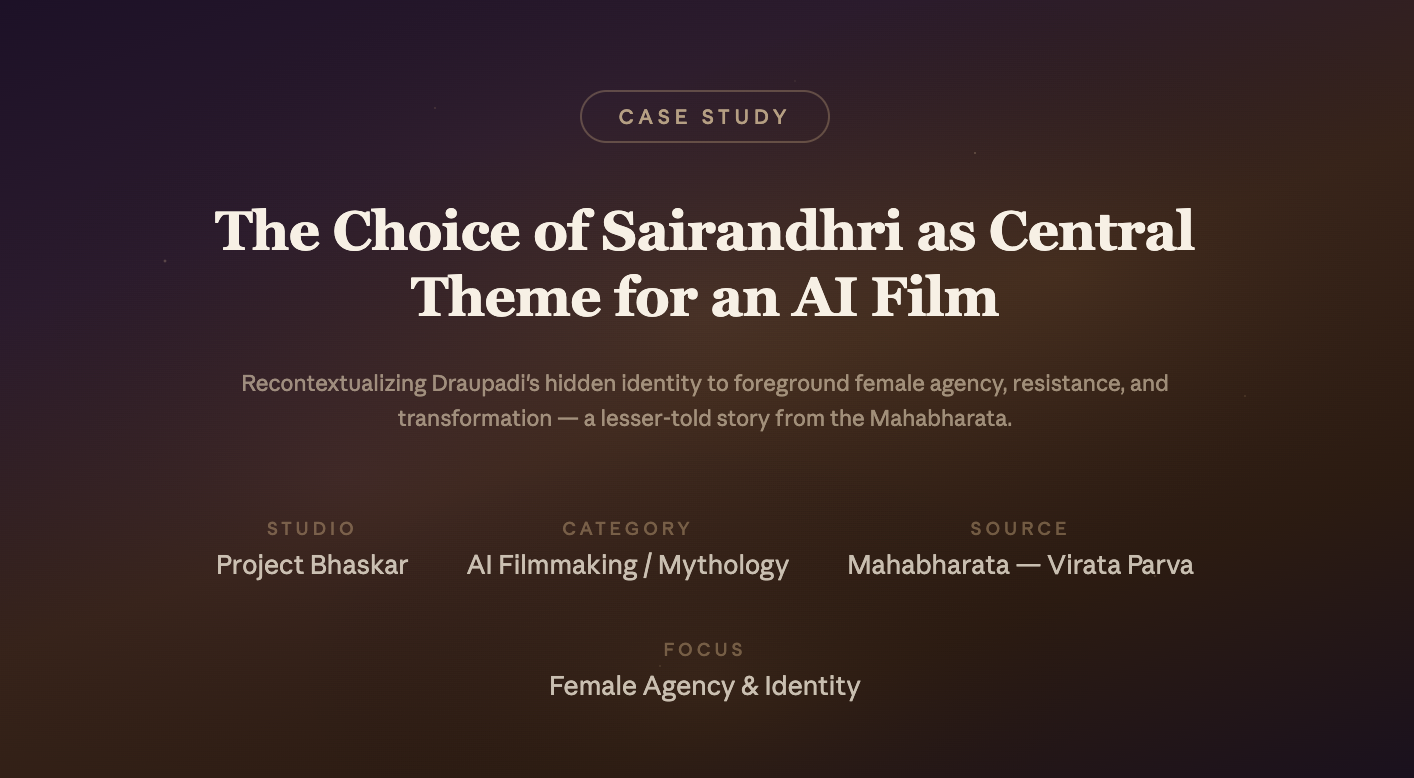
This case study documents the creative rationale behind selecting Sairandhri - the concealed identity assumed by Draupadi during the Pandavas’ thirteenth year of exile, known as the Agyatwas (or Adyatwas) -as the central theme and protagonist for an AI-generated film produced by the studio of Project Bhaskar.
The choice of Sairandhri is neither arbitrary nor merely aesthetic. It emerges from a deliberate creative thesis: that the most compelling stories in Indian mythology are not always the most frequently retold, and that the figure of Sairandhri - a queen disguised as a serving woman, navigating patriarchal power structures with nothing but her wits, her dignity, and her will - offers an extraordinarily rich canvas for exploring themes of female agency, identity under duress, and resistance against systemic oppression.
By recontextualising Sairandhri through a contemporary cinematic lens, this project aims to illuminate the enduring relevance of her story: a narrative that speaks as powerfully to modern audiences grappling with questions of gender equality and social justice as it did to its original listeners millennia ago. This document outlines the mythological context, the creative thesis, the studio’s broader commitment to lesser-told narratives, and the key lessons drawn from this undertaking.
The Context
Sairandhri: Draupadi’s Identity During the Agyatwas
In the Mahabharata, following twelve years of forest exile, the Pandavas were required to spend a thirteenth year in disguise- a period known as the Agyatwas (or Adyatwas), the year of living incognito. Discovery during this period would mean a return to the full cycle of exile, and so each of the Pandavas assumed a false identity and entered the service of King Virata of Matsya.
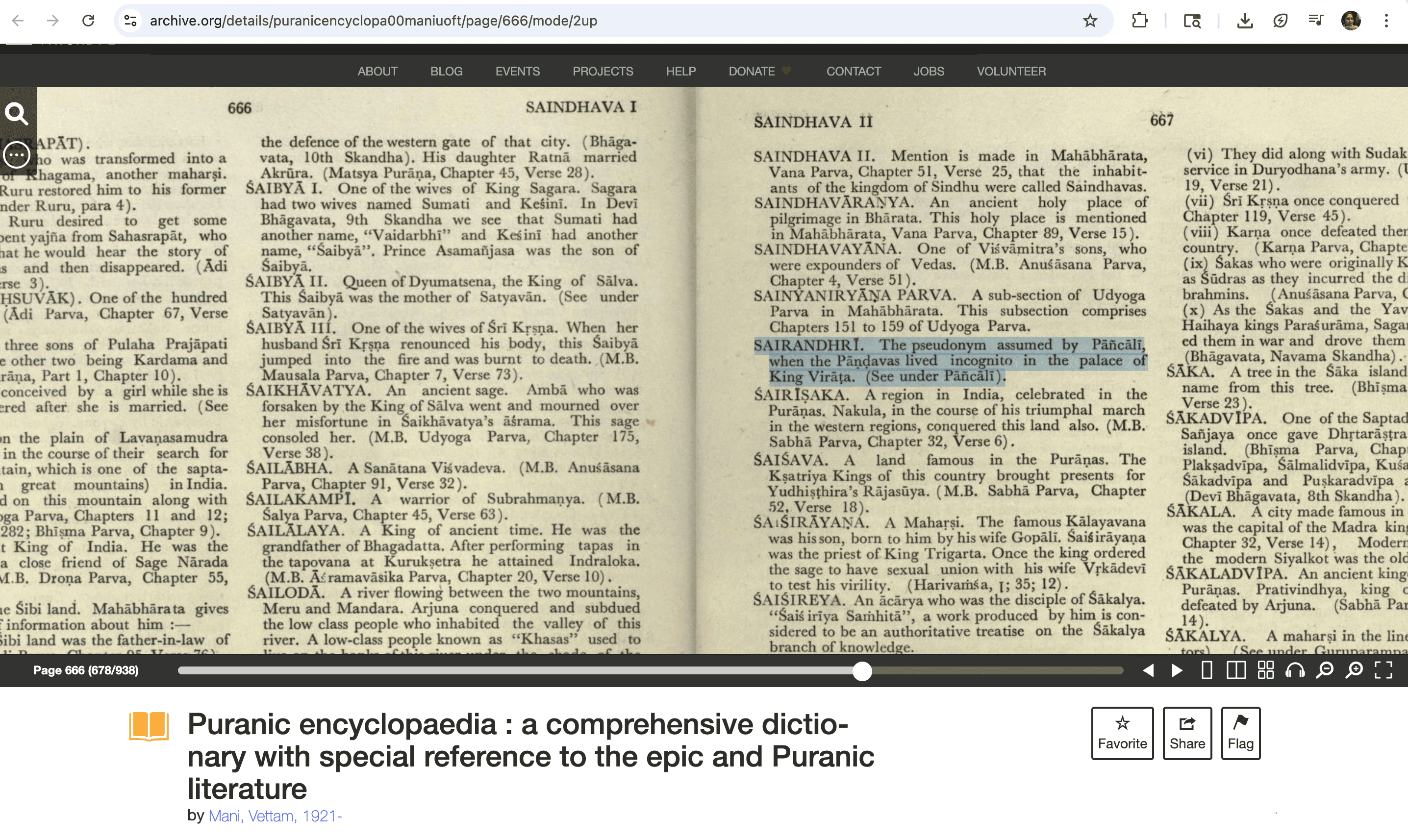
Draupadi, wife to all five Pandava princes, a queen of extraordinary intellect, beauty, and moral authority, adopted the name Sairandhri and took a position as a hairdresser and attendant to Queen Sudeshna. The transformation was staggering in its implications: a woman who commanded the court of Indraprastha, who was central to the political and moral fabric of the Pandava kingdom, is now compelled to serve in silence, her identity buried beneath the guise of an ordinary maidservant.
The Agyatwas is not merely a narrative device of concealment. It is a crucible - a period of intense psychological, emotional, and spiritual trial. For Draupadi, who had already endured the public humiliation of the infamous dice game and the trauma of being dragged by her hair into the Kaurava court, this period represents yet another layer of subjugation. But it is also, crucially, a period of profound agency exercised under constraint.
As Sairandhri, Draupadi did not simply endure. She navigated, strategised, and resisted. When Kichaka, the powerful commander of Virata’s army, pursued her with predatory intent, she did not submit. She orchestrated his destruction, working within the limitations of her disguise, leveraging alliances with Bhima, and exercising a kind of covert authority that is all the more remarkable for the powerlessness of her assumed station.
It is precisely this tension, between who Sairandhri truly is and the role she is forced to perform, that makes her story so dramatically potent and philosophically resonant.
The Thesis
Choice of Sairandhri as Central Theme & Protagonist of the Film
Recontextualising a Traditional Figure: The decision to centre our AI film on Sairandhri is rooted in a specific creative and intellectual ambition: to recontextualise a traditional mythological figure in order to foreground female agency within a patriarchal society. This is not revisionism for its own sake; it is an act of recovery. The Sairandhri episode exists in the Mahabharata, but it has historically received far less attention than the grand battles, political machinations, and philosophical discourses that dominate popular retellings. By placing Sairandhri at the centre of a standalone cinematic narrative, we aim to restore the weight and complexity of Draupadi’s experience during this critical period.
The novelist Narendra Kohli, in his own retelling of the story, provided a significant precedent for this approach. Kohli recontextualised Sairandhri as a figure of female agency who actively resists patriarchal structures - not as a passive victim of circumstance but as a woman of formidable will exercising power in the only ways available to her. Our film draws on this interpretive tradition while extending it into visual and cinematic language.
Identity vs. Position: The Central Dramatic Tension
At the heart of the film lies a tension that is both ancient and urgently contemporary: the gulf between identity and position. Sairandhri knows who she is - Draupadi, daughter of King Drupada, born of sacred fire, wife of the greatest warriors of her age, a queen who once held kingdoms in her gaze. But the world around her sees only a serving woman, a hairdresser of no consequence.
This dissonance is the engine of the narrative. Every interaction Sairandhri had in Virata’s court is layered with dramatic irony. Every indignity she suffers is amplified by the viewer’s knowledge of her true stature. And every moment in which she exercised quiet authority - refusing Kichaka’s advances, counselling patience, maintaining her composure in the face of provocation - became an act of extraordinary courage precisely because it had to be performed without the armour of her real identity.
The film explores this transformation not as a diminishment but as a deepening. In becoming Sairandhri, Draupadi did not become less than she was. She discovered dimensions of her own strength that the privileges of queenship had never required her to access. The period of concealment, paradoxically, revealed her most fully.
Patriarchal Resistance as Narrative Architecture
The film frames Sairandhri’s struggles explicitly through the lens of female agency and resistance against patriarchy. This is not an interpretive overlay imposed on the source material - it is intrinsic to the story itself. Kichaka’s pursuit of Sairandhri is a textbook exercise of male power over a woman perceived as vulnerable. His sense of entitlement, his disregard for her refusals, his willingness to use force - these are not merely ancient narrative motifs. They are patterns that remain devastatingly recognisable in contemporary life.
Sairandhri’s response to Kichaka, and to the broader structures of power that enabled his behaviour, constitutes the film’s moral and dramatic spine. She did not simply wait for rescue. She acted, planned and manipulated the systems around her to achieve an outcome that the systems themselves would never willingly grant her. In doing so, she became not merely a character surviving a difficult situation but a symbol of resistance - a figure whose strategies of navigating patriarchal power resonate far beyond the specifics of the Mahabharata’s narrative.
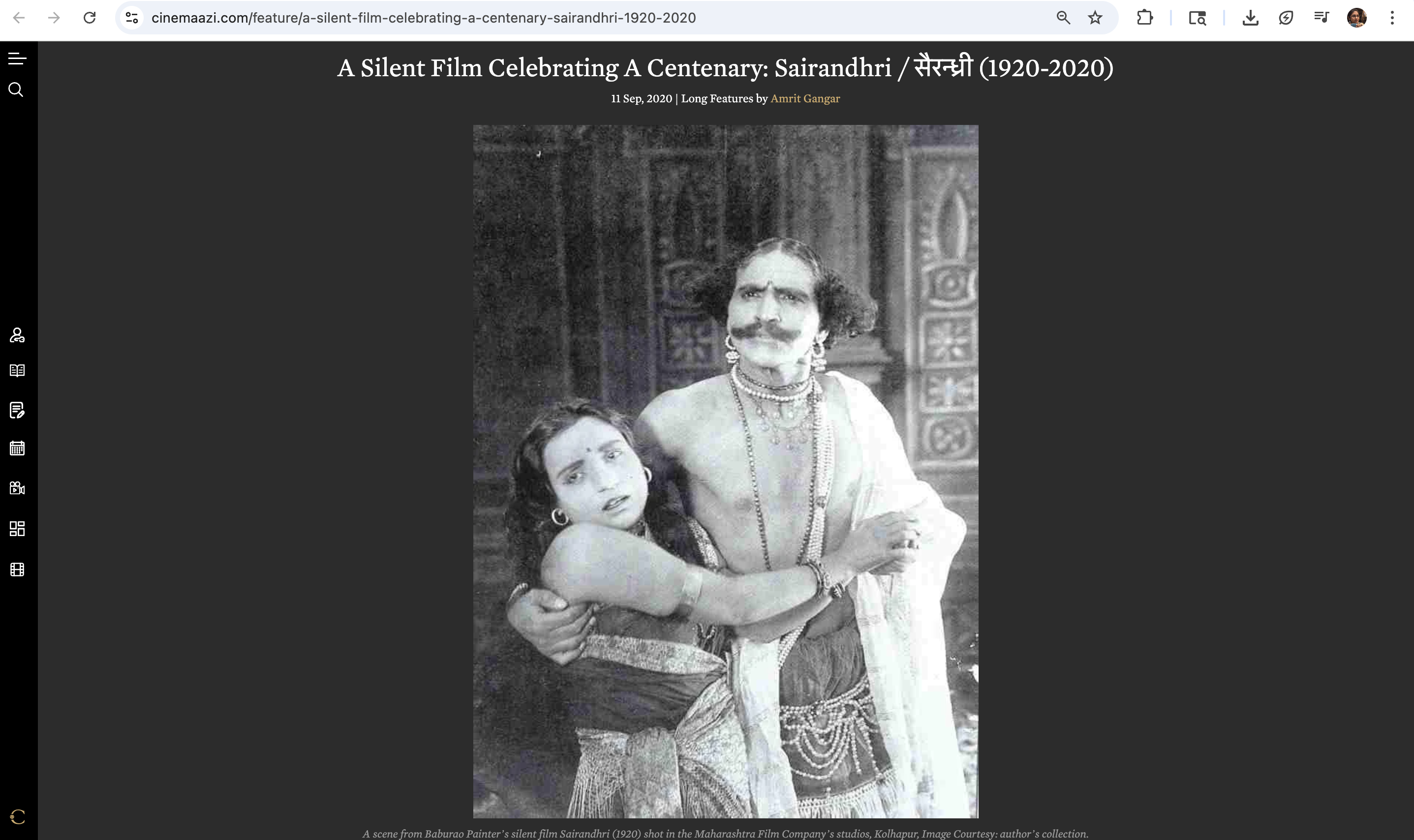
The Pathos of Draupadi’s Predicament
Any honest engagement with the Sairandhri narrative must reckon with its deep pathos. This is a woman who has already suffered enormously - the attempted disrobing in the Kaurava court, the years of forest exile, the accumulated weight of injustices that the Pandavas’ own decisions have inflicted upon her. And she had to endure still more, in silence, without even the consolation of being known.
The film does not shy away from this emotional reality. The pathos of Draupadi’s predicament is not incidental to the story; it is the central focus of it. It is what gives her moments of resistance their power, what gives her strategic intelligence its edge, and what gives her eventual emergence from concealment its cathartic force. The viewers are meant to feel the full weight of what it costs Sairandhri to be Sairandhri - and to understand that the cost is inseparable from the triumph.
Contemporary Relevance
Through the figure of Sairandhri, the film addresses modern societal issues with a directness that the mythological framework makes possible. Questions of gender equality, of the violence that institutional power inflicts on women, of the strategies of survival and resistance available to those denied formal authority - these are not abstract themes imposed on an ancient text. They are the living substance of Sairandhri’s story.
The parallels between Sairandhri’s predicament and the experiences of women in contemporary society are neither forced nor accidental. A woman of high birth and extraordinary capability, compelled by circumstances beyond her control to occupy a position of servitude, subjected to harassment and the threat of violence, denied recourse to the formal structures of justice - this is a story that could be set in any century, in any culture. The mythological setting does not distance it from the present; it universalises it.
Essentially, while Sairandhri is a traditional mythological identity, our film positions her as a central figure in a revisionist narrative that emphasizes the strength and struggles of a woman of high birth forced into a position of concealment. The ancient and the modern become inseparable, each illuminating the other.
The Focus on Lesser-Told Stories
Project Bhaskar’s Creative Philosophy for AI Films
The choice of Sairandhri is not an isolated creative decision. It reflects a broader studio philosophy at Project Bhaskar: that the most fertile ground for AI filmmaking lies in the lesser-told stories of Indian mythology - narratives that possess extraordinary dramatic and philosophical richness, but have been overshadowed in popular culture by more frequently adapted episodes.
Indian mythology is an ocean of narrative. The Mahabharata alone contains hundreds of sub-narratives, character arcs, and philosophical digressions that have rarely, if ever, been given standalone cinematic treatment. The Ramayana, the Puranas, the regional mythological traditions - all contain stories of immense power that remain largely untapped by mainstream visual media.
Project Bhaskar’s thesis is that AI filmmaking is uniquely suited to these stories. The emerging capabilities of AI-generated visual media, and its ability to create rich, atmospheric, and visually distinctive worlds at a fraction of traditional production cost, make it possible to bring these narratives to screen in ways that were previously economically prohibitive. A traditional film production might struggle to justify the investment required for a niche mythological narrative; AI filmmaking removes that barrier, enabling stories to be told on the basis of their artistic merit rather than their perceived commercial viability alone.
Moreover, the aesthetic character of AI-generated imagery - its capacity for the painterly, the dreamlike, the mythic -aligns naturally with the register of mythological storytelling. These are stories that have always existed at the boundary between the literal and the symbolic, the historical and the transcendent. AI filmmaking, with its own distinctive visual language, can honour that quality in ways that photorealistic live-action cinema sometimes cannot.
The Sairandhri project is thus both a film and a proof of concept: a demonstration that lesser-told mythological narratives, treated with intellectual seriousness and creative ambition, can produce compelling cinema - and that AI filmmaking is the ideal medium through which to realise them.
Key Lessons From This Project
Mythological Depth Rewards Serious Engagement
The Sairandhri episode, when approached with genuine scholarly and creative attention, proved to contain far more dramatic complexity than its marginal status in popular retellings would suggest. The lesson is clear: lesser-told stories are not lesser stories. They are often narratives whose complexity has made them harder to reduce to the simplified forms that popular media tends to favour. For a studio committed to artistic ambition, this complexity is an asset, not an obstacle.
Female Agency is Intrinsic, Not Imposed
One of the most significant discoveries of the creative process was that the themes of female agency and patriarchal resistance did not need to be imported into the Sairandhri narrative from contemporary feminist discourse. They are already there, embedded in the structure of the story itself. The work of the filmmaker is not to impose a modern lens on ancient material but to clear away the accumulated layers of inattention that have obscured what was always present. This matters enormously for the authenticity and cultural integrity of the finished work.
AI Filmmaking and Mythological Storytelling are Natural Allies
The aesthetic and economic characteristics of AI filmmaking proved to be remarkably well-suited to mythological narrative. The visual language of AI - its capacity for atmosphere, its comfort with the symbolic and the dreamlike - aligns naturally with the register of these stories. The reduced production costs make it possible to pursue narratives that might not survive the economic calculus of traditional production. And the rapid iteration that AI tools enable allows for a more exploratory creative process, one that can discover the visual and emotional identity of a story through experimentation rather than being locked into decisions made at the pre-production stage.
The Tension Between Identity and Position is Universally Resonant
The dramatic engine of the Sairandhri story - the gap between who a person truly is and the role they are forced to occupy - proved to be one of the most universally accessible themes in the project. The experience of performing a diminished version of oneself, of navigating systems that refuse to see one’s full humanity, of maintaining inner dignity in the face of external degradation - these are experiences that transcend the specifics of the Mahabharata and connect to something fundamental in the human condition.
Revisionist Mythology Must Be Rooted in Respect
The project confirmed that effective revisionist engagement with mythology requires deep respect for the source material. The goal is not to deconstruct or subvert the tradition but to illuminate aspects of it that have been under-explored. Audiences thus need to be sensitive to the difference between a work that loves its source material and one that merely uses it. The Sairandhri film approaches Draupadi’s story with the kind of deep respect that takes the material seriously enough to ask new questions of it.
Conclusion
The choice of Sairandhri as the central theme and protagonist for this AI film represents a convergence of creative conviction, cultural responsibility, and technological opportunity. In Sairandhri, we found a figure whose story contains everything a compelling film demands: dramatic tension rooted in the irreconcilable gap between identity and circumstance; a protagonist of extraordinary depth whose agency is exercised under conditions of extreme constraint; a narrative architecture that frames resistance against patriarchy not as a modern overlay but as the intrinsic substance of the story; and a pathos that is inseparable from the triumph it ultimately enables.
Through this project, Project Bhaskar affirms its commitment to the lesser-told stories of Indian mythology - not as curiosities or cultural footnotes, but as narratives of the first order, deserving of the same creative ambition and artistic seriousness that has historically been reserved for the more familiar episodes of the epics. AI filmmaking makes this commitment not merely aspirational but practical, offering a medium whose aesthetic sensibilities and economic realities are uniquely aligned with the demands of mythological storytelling.
Sairandhri’s story is, at its core, a story about the cost of concealment and the courage required to endure it - about a woman who carried the fire of her true self through a period of enforced darkness and emerged not diminished but deepened. It is a story that belonged to the ancient world and belongs, with equal force, to ours. In telling it, we hope to honour both.
Adaptiv Admin
@admin
Building the future of AI products at Adaptiv.Me.