Swatantrata Sangram Ke Nayak: The Stories That Stayed With Us
Adaptiv Admin
Aug 20, 2026 · 19 min read
When we opened the call for Swatantrata Sangram Ke Nayak, Project Bhaskar's second exhibition, we asked for something specific and a little unusual: not the five or six names every textbook repeats, but the one freedom fighter who had, for some personal reason, stayed with you longer than the rest.
We did not expect the response we got. Entries came in from students and working professionals, in Hindi and in English, from Ajmer and from well beyond it. Some sent a single quote and three lines. Many sent full write-ups — a case, in their own words, for why a particular name deserves to be remembered.
More people wrote about Matangini Hazra than anyone else. We've kept three of those essays here, because each one found something different in her — the widow with no formal education who led thousands to a police station at seventy-three, and would not let a bullet, or her own death, put the flag down.
But some of the entries that moved us most were about people we didn't know before this competition began: a twelve-year-old boatman in Odisha, a hunger-striker from Marwar, a weaver's son in Tamil Nadu who held a flagpole to his chest so it would never touch the ground. That, in the end, is what this exhibition was always for.
Here are the the submissions we selected for display. Our thanks to everyone who sent us a name, a memory, or an argument for someone history has been slow to credit.
Subhas Chandra Bose
Prachi Jariwala
Not every freedom fighter gives us a clean ending. This essay sits with that discomfort instead of smoothing it over.
Subhas Chandra Bose is the one who's stayed with me not because he's obscure, but because he refuses to be simple.
What pulls me in is the contradiction at his core. Here was a man from the same Congress as Gandhi, who believed deeply in freedom, but who looked at "ahimsa" and decided it wasn't enough. He walked out of the party he'd once led, went to Germany, then Japan, and built the Indian National Army out of prisoners of war and volunteers, betting that a foreign hand — even a dangerous one — might get India there faster. That's not a comfortable story. It doesn't resolve neatly into hero or cautionary tale, and I think that's exactly why it matters.
I keep coming back to the line "Give me blood, and I will give you freedom." It's not diplomatic. It's not measured. It's a man staking everything, including how history would remember him, on something he couldn't guarantee. Most freedom fighters I learned about felt like they were on the right side of a solved equation. Bose felt like someone making an actual bet, with real doubt underneath the certainty.
And then he just vanishes — a plane crash in Taiwan that official inquiries can't even agree happened. Some commissions closed the case; others reopened it, and Taiwan's own government has said it has no record of any crash that day. Nearly eighty years later, there's still no confirmed ending, just competing versions of one. There's something about a man who spent his life refusing to wait quietly for permission, and then leaves without even the certainty of how it ended.
He didn't win. His army didn't liberate India. But he's the one who makes me ask what I'd be willing to bet everything on, and whether I'd have the nerve to find out I was wrong — even if the world never fully finds out what happened to me either.
Baji Rout — The Youngest Martyr
Radhika Thakur
Twelve years old, holding an oar instead of a rifle — the youngest martyr most of us have never heard of.
When history chronicles India's struggle for independence, the bravery of children often stays hidden in regional folklore. Among them stands Baji Rout, a 12-year-old boat boy from Dhenkanal, Odisha, who remains the youngest martyr of India's freedom movement.
In October 1938, Baji was a member of the Sishu Garba (children's wing) of the local Prajamandal movement, which resisted British colonial rule. On the rainy night of October 11, a troop of armed British policemen arrived at the banks of the Brahmani River, attempting to flee after opening fire on peaceful protesters in a nearby village. They demanded that young Baji ferry them across the river to safety.
Recognizing the officers as oppressors of his people, 12-year-old Baji fearlessly refused. Even when the officers threatened him with loaded rifles, he stood his ground, asserting that he would not aid the enemies of the nation. Enraged by the child's defiance, a British soldier struck him with a rifle butt and shot him point-blank in the head.
Baji Rout died instantly on the riverbank, holding onto his oars. His supreme sacrifice at such a tender age stands as a rare and spine-chilling testament to unyielding courage.
Rani Gaidinliu
Ojas Vaidya
A reminder that the freedom struggle wasn't only fought where the cameras were.
Most people who study India's freedom struggle know Gandhi, Nehru, Bose, but almost no one learns about Rani Gaidinliu, and that's exactly why her story deserves to be told.
Gaidinliu was a Naga spiritual and political leader from Manipur who joined the Heraka movement at just 13, resisting British rule in India's Northeast, a region whose contribution to the freedom struggle is often left out of the mainstream narrative entirely. By 16, she was leading armed resistance against colonial forces, organizing local tribes to refuse British taxes and authority. The British colonial government, rattled by a teenage girl commanding real influence, arrested her in 1932 and sentenced her to life imprisonment. She spent the next 14 years in jail, refusing to bend, and was only released in 1947 after India gained independence. Jawaharlal Nehru himself gave her the title "Rani" (Queen) for her defiance, and she continued fighting, this time for the rights and recognition of Naga tribal communities, until her death in 1993.
Her story matters because it complicates the freedom struggle in a good way: it wasn't only fought in courtrooms and ashrams by well known figures, but also in the hills of the Northeast by a teenage girl who never sought fame and is barely remembered today. Telling her story is a small correction to a narrative that too often leaves out entire regions and the people who fought for them.
Balmukund Bissa — "Jatin Das of Rajasthan"
Roshan Vasnani
A name from closer to home — Marwar's own "Jatin Das."
The tide of history often leaves behind those heroes who sacrificed their lives for the defense and freedom of their motherland without any desire for fame. One such dedicated worker was Balmukund Bissa. He is also known as "Jatin Das of Rajasthan."
Balmukund Bissa was born on 24th December 1908 in a simple merchant family in Pilawa village, Didwana, Nagaur. From a young age, the flame of patriotism had burned brightly in his heart. He was also deeply influenced by the ideals of Mahatma Gandhi. He realised that to overthrow the British from India, not only political movements but also economic self-reliance was essential. With this vision, he established the "Charkha Sangh" in Jodhpur and opened the "Jawahar Khadi Bhandar." This was not only a clothing store, but had become a major secret centre for freedom fighters in Jodhpur.
During the 1930s and 1940s, when the "Praja Mandal movement" was gaining momentum in the princely states of Rajasthan, Bissa Ji took up arms against British rule in Marwar. Along with this, when Mahatma Gandhi called for the "Bharat Chodo Movement" in 1942, Balmukund Bissa led this movement in Marwar. Because of his growing popularity and influence, the British-backed princely state police arrested him on June 9, 1942, and confined him in the Jodhpur Central Jail. In Jodhpur Central Jail, freedom fighters were treated worse than criminals. They were tortured with rotten food, dirty water, and various other forms of physical pain, along with inhuman treatment. For Balmukund Bissa Ji, this inhuman behavior was unbearable. For the welfare of all the freedom fighters imprisoned in the jail, he launched a hunger strike right inside the prison walls. His hunger strike lasted for 10 days. Due to extreme deterioration in his health, he passed away on June 19, 1942.
Balmukund Bissa was a self-respecting man and a freedom fighter who possessed an unparalleled love for his nation. His entire life inspires us to dedicate everything to our country and to raise our voice against injustice.
Tirupur Kumaran — "The Guardian of the Flag"
Yashika Baresa
He held the flag to his chest so it would never touch the ground.
Tirupur Kumaran, born OKSR Kumarasamy in 1904 in Tamil Nadu, is one of the most heroic yet often overlooked figures of India's freedom struggle. Coming from a humble weaving family, Kumaran was deeply inspired by Mahatma Gandhi and devoted his youth to the nation's fight for independence.
He played a vital role in founding the Desa Bandhu Youth Association, organizing peaceful protests and rallying young citizens against British rule in Tamil Nadu. His most famous act of bravery occurred on January 11, 1932, during a banned procession in Tirupur. Protesters carrying the Indian national flag — which was strictly prohibited by British authorities — were brutally attacked by police.
Despite suffering fatal injuries from police batons, Kumaran refused to let the Indian flag fall. He collapsed to the ground holding the flagpole tightly against his chest, ensuring that the national symbol never touched the dirt. He succumbed to his injuries the following day at the young age of 27.
His unwavering devotion earned him the revered title "Kodi Kaatha Kumaran" (Kumaran who saved the flag). Tirupur Kumaran's supreme sacrifice serves as an enduring symbol of courage, selflessness, and deep patriotism.
Matangini Hazra: The Woman Who Would Not Let Go
Laksh Kumar Batra
Among the many stories of India's freedom struggle, the one that stays with me is the story of Matangini Hazra.
What moves me most about her is not simply that she was brave. It is that she was already an elderly woman when she chose to stand at the front of a freedom movement. She could have told herself that the struggle belonged to the younger generation. She could have stayed safe. Instead, she stepped forward.
In 1942, during the Quit India Movement, Matangini Hazra marched with thousands of protesters, carrying the Indian flag. The British police opened fire. She was shot, yet she kept walking. She kept holding the flag. Even as her life was slipping away, she continued calling out "Vande Mataram."
I often wonder what gives a person the strength to keep moving forward when everything is telling them to stop.
That is why Matangini Hazra matters to me. Her story reminds me that courage is not the absence of fear. Sometimes, courage is simply refusing to let fear decide what you do.
She did not know whether she would live to see a free India. But she walked forward anyway, carrying a flag for a future she might never see.
And perhaps that is the most beautiful kind of courage: to sacrifice for a freedom that someone else will one day enjoy.
Kanaklata Barua: Courage Beyond Her Years
Irena Morwani Mankani
When I think of a freedom fighter, I do not imagine someone who was fearless. I imagine someone who was afraid, but chose to stand up anyway. That is why Kanaklata Barua has stayed with me.
Kanaklata was only seventeen when she joined India's struggle for independence. During the Quit India Movement in 1942, she led a procession towards a police station in Gohpur, Assam, carrying the Indian national flag. The police warned the protesters to stop. She refused. As she moved forward, she was shot and killed, still holding the flag.
What strikes me most about Kanaklata is not simply that she died young. It is that she was young and still believed that her voice mattered. She did not have extraordinary power, money or influence. She had courage, conviction and a flag in her hands.
Her story reminds me that making a difference is not about being the strongest or the most famous person in the room. Sometimes, it is about taking one step forward when everyone is telling you to step back.
Kanaklata makes me ask myself: If I truly believed in something, would I have the courage to stand for it?
I may never be able to match her bravery, but I can carry her lesson with me: age does not decide the size of your courage.
General Thangal
Radhika Sankhla
A rare entry into a decade most of these write-ups didn't reach — 1891.
General Thangal was a courageous military leader from Manipur who played an important role in resisting British expansion in India. He served as a senior commander of the Manipur forces and became one of the key figures during the Anglo-Manipur War of 1891. When the British attempted to interfere in the internal affairs of Manipur and impose their authority, General Thangal stood firmly against them. Along with other Manipuri leaders, he helped organize and lead the defence of the kingdom against British forces. Despite being considerably outnumbered and facing a powerful colonial army, he refused to surrender his homeland without resistance. His leadership represented the determination of the people of Manipur to protect their independence and sovereignty. After the British defeated the Manipuri forces, General Thangal was captured and sentenced to death. He was executed in 1891 along with other prominent Manipuri leaders. Although his name is not as widely remembered as many other freedom fighters, his courage, sacrifice, and commitment to his homeland make him an important figure in India's struggle against colonial rule. General Thangal's story reminds us that India's freedom struggle was fought by people from every region, including those whose sacrifices have remained largely unknown.
Matangini Hazra: The Courageous "Gandhi Buri"
Radhika
Matangini Hazra, affectionately known as 'Gandhi Buri' (Old Lady Gandhi), is an unsung heroine of the Indian independence movement whose story deserves widespread recognition. Born into poverty in a small village in West Bengal, she lacked formal education but possessed an unyielding love for her motherland. She became an active participant in the Nationalist movement, heavily inspired by Mahatma Gandhi's principles of non-violence.
Her ultimate act of bravery occurred during the Quit India Movement in September 1942. At the age of 73, Hazra led a peaceful procession of thousands of freedom fighters toward the Tamluk police station to hoist the Indian National Flag. As the crowd advanced, British authorities opened fire. Undeterred, she stepped forward, holding the tricolor high and chanting "Vande Mataram." Even after being shot multiple times in both hands and her forehead, she refused to let the flag touch the ground, continuing her march until she collapsed.
Her tragic yet deeply inspiring sacrifice symbolizes the fierce resilience and immense contributions of women in India's struggle for liberty. While mainstream history books often focus on prominent centralized leaders, ordinary individuals like Matangini Hazra formed the true backbone of the movement. Her story must be kept alive to remind future generations that freedom was won through the silent, relentless courage of everyday people who laid down their lives without ever seeking fame or power.
मातंगिनी हाज़रा
Chanchal
मातंगिनी देवी भारत के प्रमुख स्वतंत्रता सेनानीयो में से एक रही, इनका जीवन अत्यंत कठिनता से पूर्ण रहा, छोटी उम्र में इनकी शादी एक बहुत बड़ी उम्र के आदमी से कर दी गई जब वे मर गये तो मातंगिनी देवी को बहुत प्रताड़नाएं सहनी पड़ी, किंतु वो डरी नहीं बल्कि पूरी शक्ति और विश्वास से देशभक्ति की। 1942 के भारत छोड़ो आंदोलन के दौरान मातंगिनी हाज़रा ने अंग्रेजों के विरुद्ध आंदोलन में महत्वपूर्ण भूमिका निभाई। वे उस समय लगभग 72 वर्ष की थीं, लेकिन उम्र उनके साहस के सामने बाधा नहीं बनी।
29 सितंबर 1942 को वे हजारों लोगों के एक जुलूस का नेतृत्व कर रही थीं। उनके हाथ में भारतीय राष्ट्रीय ध्वज था और वे आगे बढ़ते हुए लोगों का नेतृत्व कर रही थीं।
पुलिस ने जुलूस को रोकने की कोशिश की। गोली चलने के बावजूद मातंगिनी हाज़रा पीछे नहीं हटीं। उन्हें कई गोलियाँ लगीं, लेकिन वे लगातार "वंदे मातरम्" का उद्घोष करती रहीं और तिरंगे को अपने हाथों में ऊँचा रखे रहीं।
अंततः वे शहीद हो गईं, लेकिन उनके हाथों से राष्ट्रीय ध्वज नीचे नहीं गिरा।
"मातंगिनी हाज़रा का जीवन हमें सिखाता है कि सच्ची देशभक्ति के लिए उम्र, गरीबी या कठिन परिस्थितियाँ कभी बाधा नहीं बन सकतीं।"
मेरे लिए ये इसलिए जरूरी है कि:-
जहाँ आज हम आज कल की लड़कियां छोटी छोटी बातों पर अपना जीवन त्याग देती है, वही मातंगिनी देवी ने संघर्ष के साथ अपना जीवन जिया।
हम अक्सर अपने पिछले समय की परेशानियों को ले के बैठे रहते है लेकिन इन्होंने हमें सिखाया कि जो हो गया उसके बारे में ज्यादा न सोच कर जो करना है उसके बाते में सोचना चाहिए।
जहां औरत को अबला समझा जाता है वही मातंगिनी देवी स्वयं सबल का उदाहरण है।
वो कहावत है न कि नारी यदि शंका त्याग दे तो स्वयं शंकर बन जाती है, मातंगिनी देवी उसी का उदाहरण है।
मैं मातंगिनी हाजरा को न सिर्फ देश भक्ति बल्कि नारी सशक्तिकरण के लिए भी महत्वपूर्ण मानती हूँ ओर देश की हर नारी को ये संदेश देना चाहती हूं कि
"कोमल है कमजोर नहीं तू शक्ति का नाम ही नारी है, जग को जीवन देने वाली मौत भी तुझसे हारी है।"
धन्यवाद। जय हिंद। जय भारत।
Alongside the Open write-ups above, our School and Junior categories brought in their own set of winners — essays, portraits, and quote cards, each chosen the same way: for the story behind why this person, and not someone else.
School Category
Saraswathi Rajamani
Yogini Yadav — Biography
Saraswathi Rajamani was a brave and lesser-known freedom fighter who played an important role in India's struggle for independence. She was born on 11 January 1927 in Rangoon (now Yangon), Burma. Her family was wealthy, and her father owned a gold mine. Despite growing up in a comfortable family, Saraswathi was deeply inspired by the idea of India's freedom.
At the age of 16, she met Netaji Subhas Chandra Bose and was greatly influenced by his vision and courage. She donated her jewellery to the Indian National Army (INA). Impressed by her dedication, Netaji recruited her into the Rani of Jhansi Regiment. She later worked as an intelligence operative for the INA.
Saraswathi often disguised herself as a boy named "Mani" to collect information about British military activities. During one mission, she helped an INA member escape and was injured while trying to get away.
After India became independent, she settled in Chennai and lived a simple life. She remained proud of her association with Netaji and the INA. Saraswathi Rajamani died on 13 January 2018, at the age of 91. She is remembered as a courageous and dedicated freedom fighter whose contribution deserves greater recognition.
अल्लूरी सीताराम राजू
जंगलों के बेनाम नायक · Priyanshi Singhwahia
भारत का स्वतंत्रता संग्राम केवल बड़े शहरों और बहुचर्चित नेताओं तक सीमित नहीं था, इसकी जड़ें दूर-दराज़ के जंगलों और आदिवासी आँचलों में भी गहराई से फैली थीं। ऐसे ही एक गुमनाम और अदम्य स्वतंत्रता सेनानी थे अल्लूरी सीताराम राजू, जिन्हें स्थानीय लोग प्यार और आदर से "मन्यम वीरुडु" (जंगल का नायक) कहते थे। उनका जन्म 4 जुलाई 1897 को आंध्र प्रदेश के विशाखापत्तनम ज़िले में हुआ था और बचपन से ही उनके भीतर देशभक्ति तथा सामाजिक न्याय के प्रति गहरा लगाव था। जब ब्रिटिश सरकार ने 1882 के मद्रास फ़ॉरेस्ट एक्ट के तहत आदिवासियों के पारंपरिक कृषि अधिकारों और जंगलों पर उनके हक़ को छीनना शुरू किया, तो उन्होंने शोषितों की आवाज़ बनने का दृढ़ संकल्प लिया।
शुरुआत में महात्मा गांधी के असहयोग आंदोलन से प्रेरित होकर उन्होंने आदिवासियों को शराब छोड़ने, आत्मनिर्भर बनने और ब्रिटिश अदालतों का बहिष्कार करने के लिए जागरूक किया। हालांकि, जब अंग्रेजों का अत्याचार असहनीय हो गया, तब राजू ने आदिवासियों को संगठित करके ऐतिहासिक रम्पा विद्रोह (1922-1924) की शुरुआत की। उन्होंने पूर्वी घाट की कठिन पहाड़ियों में छापामार युद्ध की रणनीति अपनाई और पारंपरिक धनुष-बाण से लैस आदिवासियों की एक निडर गुरिल्ला सेना तैयार की। अंग्रेजों से हथियार हासिल करने के लिए राजू और उनके साथियों ने चिंतापल्ली और राजावोमंगी जैसे कई पुलिस थानों पर साहसिक छापे मारे। उनकी निडरता का आलम यह था कि वे थानों पर हमला करने से पहले ब्रिटिश अधिकारियों को बकायदा पत्र लिखकर चेतावनी देते थे, जिससे औपनिवेशिक प्रशासन में खौफ बैठ गया था।
अंग्रेज सरकार ने इस जन-विद्रोह को कुचलने के लिए भारी पुलिस बल और 'असम राइफल्स' की टुकड़ियों को मैदान में उतारा। अंततः 7 मई 1924 को एक भीषण मुठभेड़ के दौरान उन्हें धोखे से बंदी बना लिया गया और बिना किसी मुकदमे के पेड़ से बांधकर गोली मार दी गई। मात्र 26 वर्ष की अल्प आयु में अल्लूरी सीताराम राजू मातृभूमि की रक्षा करते हुए अमर हो गए। मुख्यधारा के इतिहास की किताबों में भले ही उन्हें वह स्थान न मिला हो जिसके वे हकदार थे, लेकिन आदिवासियों के दिलों और आंध्र प्रदेश के लोकगीतों में उनकी वीरता आज भी पूरे गौरव के साथ जीवित है।
Submitted Artwork
Ram Prasad Bismil — portrait study, pencil and colour Dimple Bundel, School Category
मातंगिनी हाज़रा — तिरंगे की आख़िरी पकड़ Quote card · Kapil Rawat
Junior Category · Special Mention
Rani Lakshmi Bai — illustration Paridhi Mathur, Sophia School, Class 9
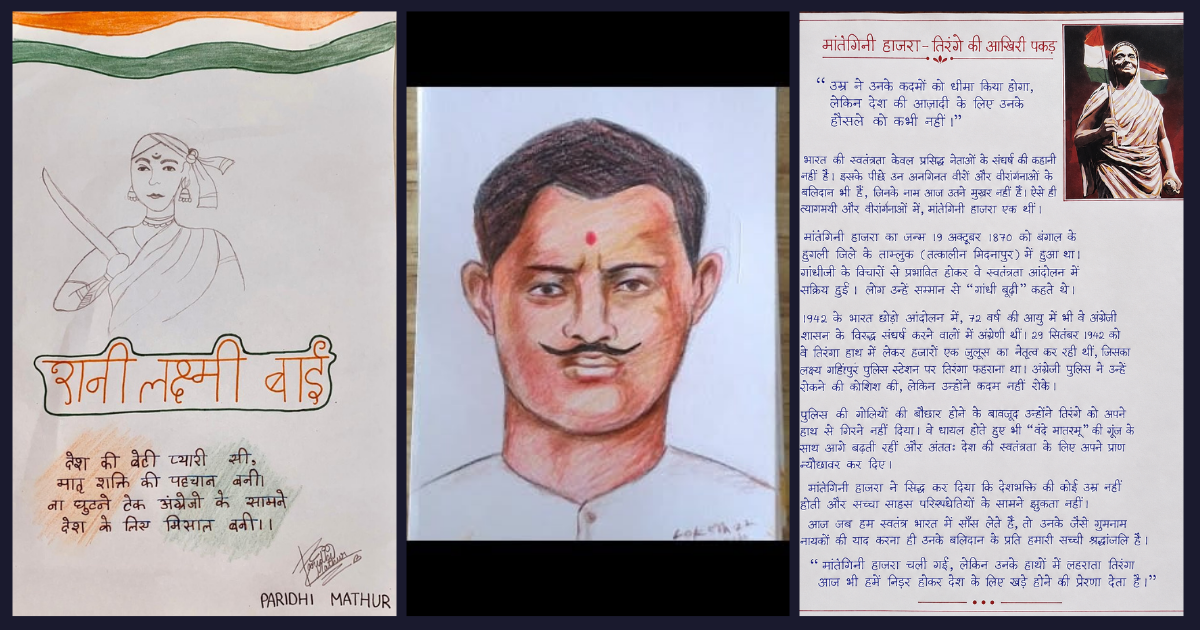
These entries — essays, portraits, and quote cards alike — will be printed and displayed at the Bhaskar office through the rest of the month, alongside the exhibition. Our thanks to everyone in Ajmer and beyond who sent us a name worth remembering — and to the freedom fighters themselves, most of whom asked for nothing in return for what they gave.
Adaptiv Admin
@admin
Building the future of AI products at Adaptiv.Me.