What if cities were the real museum?
Adaptiv Admin
May 15, 2026 · 5 min read
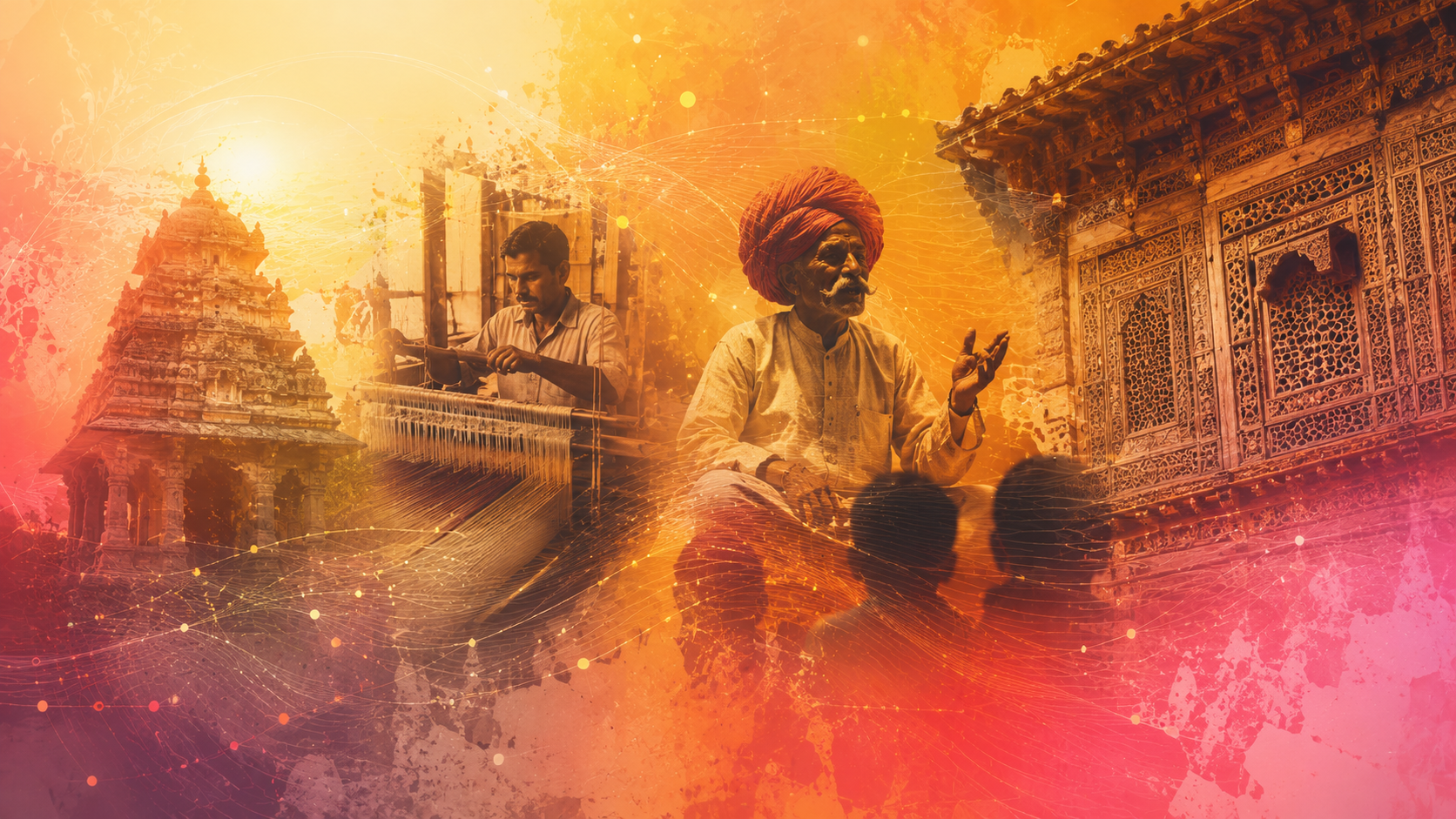
There is a shrine in Tamil Nadu that has been in continuous use for over 1,000 years. A weaver in Varanasi whose family has worked the same loom for seven generations. A storyteller in Rajasthan who carries, in memory, an oral epic that has never been written down. A building in the old city of Ahmedabad whose carved wooden facade contains architectural knowledge that no living craftsperson could fully replicate.
None of these are in a museum, but all of them are more valuable than most things that are. This is the paradox at the heart of heritage preservation in India - and the question that International Museum Day should be asking more loudly than it does.
The glass case problem
The traditional museum model rests on a set of assumptions that made sense when they were developed and are now worth examining carefully:
Preservation requires removal: the way to save a thing is to take it out of circulation, away from use, away from the conditions that created it, and place it somewhere it can be observed but not touched.
Context is secondary: that what matters is the object itself, and that meaning can be provided separately, through labels and audio guides and educational programmes written by people who were not there when the thing was made.
Passive viewing is sufficient: preservation is achieved when something can be seen, regardless of whether it is understood, practised, loved, or continued.
These assumptions have saved things that would otherwise be gone. Climate-controlled vaults have preserved manuscripts that humidity would have destroyed. Museum collections have protected objects that would have been lost to conflict, neglect, or the simple entropy of time.
But they have also created a particular relationship between people and their own heritage - one of distance, of spectatorship, of the guilt that attends looking at something beautiful through glass you cannot touch, in a building you visit once and leave.
India's real archives
India's most important cultural archives are not in museums.
They are in the Carnatic music tradition, transmitted entirely through oral instruction between teacher and student for over 2,000 years. In the Warli paintings of Maharashtra, where tribal geometry encodes a relationship with the natural world that no anthropologist has fully decoded. In the Gondi language of central India, whose vocabulary for forest ecosystems contains ecological knowledge that exists in no field guide. In the backstreet workshops of Jaipur where block-printing techniques developed over centuries are still practised by families who learned them from their grandparents.
They are in the cities themselves from Varanasi, Madurai and Ajmer to Hampi and Patan - places that have been continuously inhabited for centuries and carry their history not in exhibits but in streets, in buildings, in the daily rituals of the people who live there.
These archives are not behind glass. They are alive. They are in use. And like all living things must, they are also changing and thus at risk in ways that no museum acquisition policy is designed to address.
What is actually threatening them
The threat to India's living heritage is not the absence of preservation. It is the absence of conditions that make continuation possible.
A weaver in Kanchipuram cannot find an apprentice because the economics of handloom weaving cannot compete with power looms. A Madhubani artist in Bihar cannot earn a living from her work because the market for it is controlled by intermediaries who take the margin and leave her with a day rate. A Gondi elder in Chhattisgarh has no platform, no digital presence, no way to transmit what she knows to a generation that is entirely online.
An archived record of their work, however beautifully curated, does not solve any of these problems.
What solves them is economic viability, which can be solved through digital visibility. The presence of younger people who see a future in the tradition. The existence of audiences (readers, listeners, viewers, buyers) who know these things exist and choose to engage with them.
A different kind of museum
Project Bhaskar was built on the conviction that culture survives through use, not through storage.
The work we are doing in documenting living traditions across India, building tools like Be A Reader to reconnect people with regional literature, creating spaces where heritage is discussed and debated rather than displayed is based on a simple observation: the things most worth preserving are precisely the things that cannot survive being put behind glass.
A language that is only spoken by elders is a language in retreat. A craft that is only demonstrated at heritage festivals is a craft preparing to disappear. A literary tradition that exists only in university syllabi is a tradition that has already lost the argument.
Documentation matters. We need to do it, urgently, using every tool available including AI. But documentation is the record of what existed, not the thing itself.
The museum of the future should look less like a building with a ticket counter and more like a city that has been helped to remember what it is. Less like a collection and more like a conversation. Less like an institution and more like a practice - daily, distributed, alive in the hands of people who have chosen to continue it.
India has more raw material for that museum than almost any country on earth.
The question is not whether it is worth preserving.
The question is whether we will move fast enough.
Project Bhaskar is building a space where India's cultural knowledge and technological future meet through research, documentation, revival, and the simple act of reading. If this matters to you, and you would like to be a part of the work we are doing, or collaborate, drop us a note on hello@adaptiv.me.
Follow us. Read with us. Build with us.
Adaptiv Admin
@admin
Building the future of AI products at Adaptiv.Me.