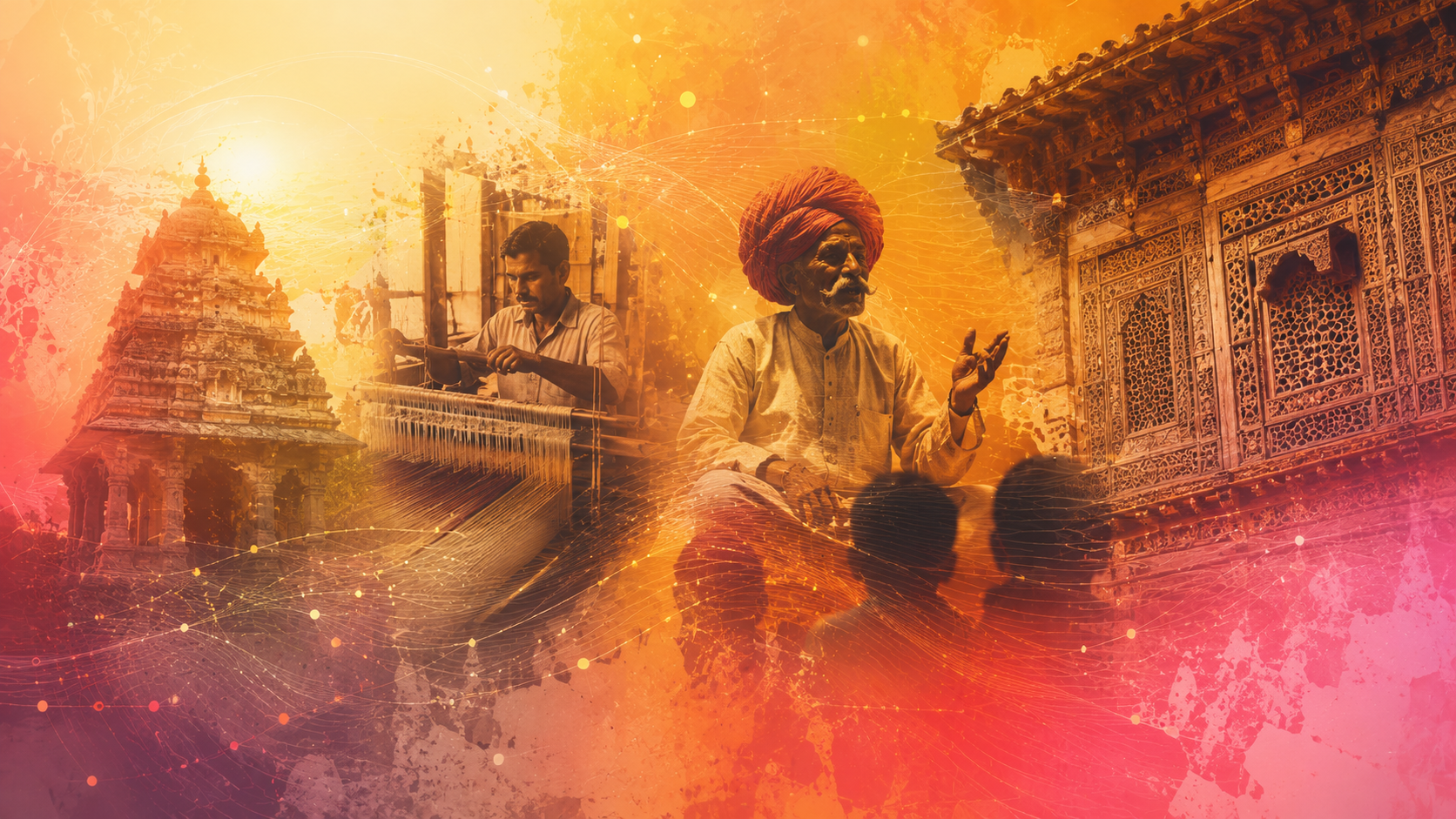
Why India Must Build Its Own Cultural AI
Adaptiv Admin
May 29, 2026 · 8 min read
There is a particular kind of invisibility that neither announces itself, nor feels like exclusion. It just feels like the way things are. For most of the last few years, that is what AI has felt like for the majority of Indian users - systems that work, more or less, but were never quite designed for you: they don't think in your language and they don't carry your references. They were built somewhere else, for someone else, and graciously extended outward. We were mere users, not authors.
That is the problem Project Bhaskar exists to fix. Not as a sentiment, but as an engineering and cultural agenda.
The Industry Getting Culture Tech Wrong
Globally, Culture Tech is having a moment. Investors are waking up to something that researchers have known for a while: cultural engagement is not a leisure activity. It is infrastructure. Companies that build genuine cultural resonance into their identity rather than renting attention through ad spend show 40–60% greater long-term cost efficiency in brand awareness. Regular cultural participation is measurably linked to lower rates of dementia, depression, frailty, and loneliness. The numbers are not soft. The case is not aesthetic. Culture, at scale, is a public health and economic intervention.
But most of the money and most of the technology is flowing toward a very narrow definition of culture. Western archives. English-language models. Heritage experiences designed for Western museum-goers. The implicit assumption is that the "universal" baseline of cultural AI is actually already universal - that a model trained predominantly on English text, Greek philosophy, and European history is simply intelligent, and that everyone else's knowledge traditions are edge cases to be handled later.
That assumption is becoming impossible to accept.
5,000 Years Is Not an Edge Case
India is not a developing market waiting to catch up to a cultural AI that was built without it. India is one of the deepest sources of the raw material that intelligence, whether human or artificial; is supposed to be made of.
The subcontinent has produced continuous, sophisticated traditions of logic, epistemology, linguistics, ethics, aesthetics, and governance across five millennia. Sanskrit alone contains one of the most systematically developed grammars in human intellectual history. The philosophical frameworks of Nyaya, Vedanta, Buddhism, and Jainism wrestled with questions about the nature of mind and knowledge that AI researchers are only now beginning to formalise. This isn't heritage in the museum sense - objects behind glass, safely in the past. It is live intellectual material that has direct relevance to how we build systems that are meant to understand, reason, and act in the world.
None of it is adequately represented in the models that most Indians use every day.
This is what we mean when we talk about the politics of absence in Culture Tech - the way certain histories and knowledge systems get quietly omitted from the canonical record, not through malice but through the compounding effect of who was in the room when the decisions were made. The result is AI that can discuss Aristotle fluently but stumbles over Adi Shankaracharya. Systems that handle English idiom with ease but treat Hindi, Tamil, or Bengali as lower-priority languages in their own country, as we realised recently.
Bhaskar's first pillar - Indic Language Models - is a direct response to this. LLMs and SLMs built for every Indian language, from Hindi to Sanskrit, grounded in the cultural and philosophical context those languages actually carry. Not translated, or approximated, but built from within.
The Cultural AI Stack India Doesn't Have Yet
Language is the entry point, but the problem runs deeper. Consider what a genuinely Indian cultural AI stack would need to include:
Education and tourism and arts shaped by Indian context, not imported frameworks. The way history is taught, the way heritage sites are experienced, the way classical art forms are explained to a new generation - all of this currently runs on infrastructure that either ignores India's traditions or misrepresents them. Bhaskar's Native AI Applications pillar is building the education, tourism, and arts tools that Indian communities actually need, designed by people who understand what those communities are engaging with.
Media that tells Indian stories in Indian voices. The global streaming boom has created unprecedented appetite for Indian content, but the production pipeline - the tools for documentary-making, historical storytelling, generative media - is still overwhelmingly Western. Bhaskar's AI-Generated Media pillar is building the films, documentaries, and podcasts that bring Indian history and heritage to life using generative AI - not as novelty, but as a genuinely new medium for cultural transmission.
Talent that can actually build this. Here is where most conversations about cultural AI quietly fall apart. The ambition is stated, the investment is announced, and then the work is handed to people trained entirely in frameworks developed elsewhere, with no particular grounding in the cultures they are supposed to be encoding. Real cultural AI requires people who carry the knowledge - not just as a subject of study but as a living context. Bhaskar's Talent Development pillar - bootcamps, fellowships, training programs aimed specifically at Tier-2 and Tier-3 youth - is an acknowledgment that the people who should be building this have largely been locked out of the rooms where it gets built.
And none of this works without genuine community ownership. The Community Engagement pillar - open workshops, cultural hackathons, public dialogues on AI ethics and cultural sovereignty - is not a PR exercise. It is a recognition that culture cannot be built for communities by technologists who don't belong to them. The communities that carry these traditions have to be the ones shaping how those traditions are encoded, preserved, and extended. That is not a philosophical nicety. It is a technical requirement for getting it right.
The Deeper Argument: What Intelligence Actually Is
There is a version of this argument that stays safely in the domain of market opportunity. India is a 1.4 billion person economy with enormous unmet demand for culturally relevant AI. The TAM is large. The competition is low. Invest now.
That argument is true, but it misses what is actually at stake.
The dominant assumption in AI development has been that intelligence is culture-neutral. That you can build a sufficiently capable model on a particular body of text and knowledge, and the result will be generically smart - applicable anywhere, by anyone, with minor localisation adjustments. Bhaskar's founding premise is that this assumption is wrong, and that the error is not merely technical but philosophical.
Intelligence - real intelligence, the kind that the Indian philosophical tradition spent centuries trying to understand - is not separable from context, values, and understanding. Prajña is not a synonym for processing speed. The Nyaya school's rigorous epistemology was not just early logic; it was an account of how a knowing subject relates to a world that has moral weight. Ancient Indian conceptions of learning were never about information accumulation alone; they were always about formation - the shaping of a person who could act wisely in a complex world.
A technology built on the premise that these traditions have nothing to contribute to how we design intelligent systems is not neutral. It is impoverished.
Bhaskar's vision - where Indian wisdom meets modern AI, where "smart, kind, fair, and meaningful" technology is a design specification, not a tagline - is an attempt to build something less impoverished. Systems that bring ancient Indian ideas about ethics and learning into genuine dialogue with cutting-edge AI research. Not as a cultural garnish on top of a Western model, but as a different starting point entirely.
Built in Tier-3 India, For the World
There is one line in Bhaskar's founding vision that deserves to be read slowly: built in Tier-3 India, for the world.
Not built in Bangalore for global export. Not built in Silicon Valley with Indian themes. Built in Ajmer, in the heartland, by people who are not performing a relationship to Indian culture but simply living it - and who are, perhaps for the first time, being given the tools to encode it.
This matters for the obvious reasons of equity and access. It matters for the less obvious reason that proximity to living culture produces different and better artefacts than distance from it. The best cultural AI will be built by people who dream in the languages it needs to understand.
The digitisation of the Vatican Library and the 3D reconstruction of Palmyra showed what is possible when serious resources are applied to cultural preservation. But those were rescue operations - last-minute salvage of things nearly lost. What Bhaskar is attempting is different: not preservation of a dying past but active extension of a living tradition into a new technological medium.
India's cultural heritage does not need to be rescued. It needs to be recognised - as source material, as intellectual infrastructure, as the foundation for a genuinely different kind of AI.
The companies and nations that figure this out will own the next decade of Culture Tech. More importantly, they will have built something that actually reflects the full range of human intelligence, and not a Western approximation of it.
That work is already underway. The question is whether the rest of the world is paying attention.
Adaptiv Admin
@admin
Building the future of AI products at Adaptiv.Me.