Case Study: How Ask Sétu Was Built to Guide Indian Students Through Every Stage of Life in France
Adaptiv Admin
Mar 27, 2026 · 14 min read
Executive Summary
Every year, thousands of Indian students choose France for higher education, drawn by affordable tuition, world-class engineering and business schools, and the pull of Europe. But the journey rarely unfolds smoothly. From deciphering which school to apply to, to finding housing and setting up a bank account, students face a continuous stream of high-stakes decisions in a language and system that feel deeply foreign.
Ask Sétu was built to change that. It is an AI-powered guidance platform backed by human experts, designed to support students and expats at every stage of their French experience - from choosing a programme to landing a first job. This case study explores the problem, the design choices, the technology, and the lessons learned along the way.
The Challenge
Moving to France is not one problem. It is twenty problems arriving at once.
The Indian student's path to France involves a cascade of decisions and bureaucratic processes, each unfamiliar and each consequential. Miss a Campus France deadline and you lose a full application cycle. Arrive with a CV formatted for India and watch job applications disappear into silence.
The challenge breaks down into four distinct but deeply connected phases, each representing a moment where students lack the right information at the right time.
Course selection paralysis. The French higher education system, with its dual structure of universities and Grandes Écoles, its competitive preparatory classes, and its language requirements, is genuinely hard to decode from abroad. Students often choose institutions based on hearsay, rankings they don't fully understand, or the experience of a cousin from a different academic field.
The arrival wall. Landing in France with a confirmed admission does not mean you're set. Finding an apartment without a French guarantor, opening a bank account as a non-resident, registering at CPAM, and navigating an unfamiliar city — all of this hits in the first two weeks, in a second language, often completely alone.
Academic and cultural disorientation. French universities have a distinct pedagogical culture. Participation norms, examination formats, professor relationships, and group dynamics differ sharply from Indian institutions. Students who thrived academically at home often struggle badly in their first semester.
The career cliff. At graduation, Indian students discover that French CVs look nothing like Indian ones, that networking culture operates by different rules, and that translating a French master's degree into employment, in France or back home, requires navigating a set of unwritten conventions nobody warned them about.
Why Existing Solutions Weren't Enough
Information about studying in France is not scarce. Campus France has a website. YouTube is full of vlogs from Indian students in Lyon and Paris. Instagram reels offer quick, bite-sized glimpses into student life. WhatsApp groups circulate tips. Facebook communities answer questions. And yet none of these solved the core problem.
"The information exists. It is just fragmented, buried, and outdated, and none of it knows you, your background, or where you are in the process."
Consultancies offer guided support, but with a narrow focus on admissions. They disappear the moment a student boards the plane. Peer networks provide warmth and lived experience but lack consistency, advice from a student in Bordeaux in 2021 may be entirely wrong for someone enrolling in Strasbourg in 2025.
The fundamental failure of existing resources was that they were built around supply - "here is information" - rather than around the student's moment of need. A student at 11pm trying to understand whether their titre de séjour application status is normal doesn't need a PDF. They need a conversation.
What was missing wasn't more information. It was a single intelligent layer that could receive a question in plain language, retrieve the most current and relevant answer, and hand off to a human expert when the complexity required it.
The Solution
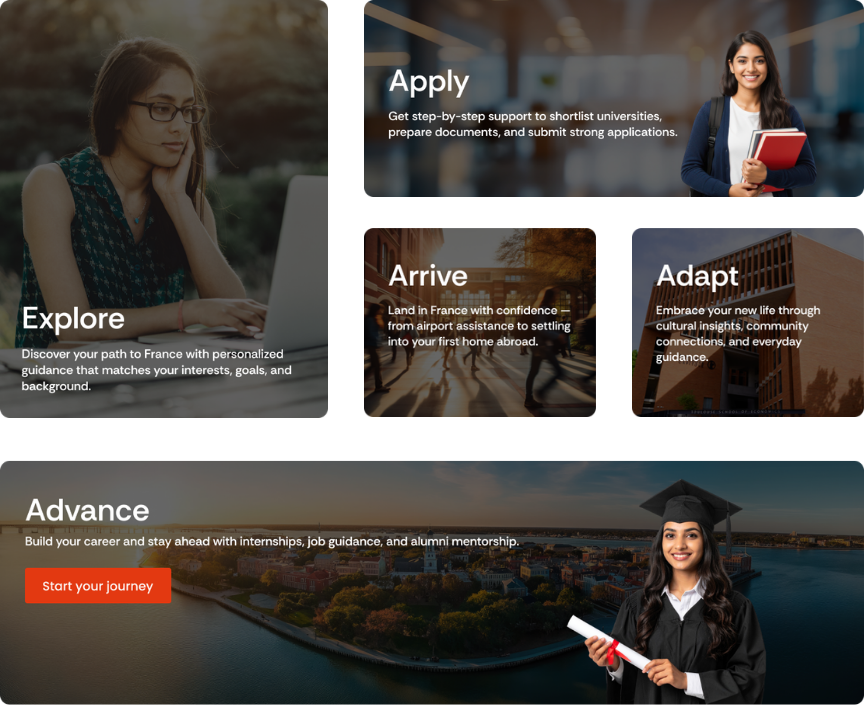
Ask Sétu is structured around five stages of a student's French journey: Explore, Apply, Arrive, Adapt, and Advance. Each stage has distinct information needs, and the platform is designed to meet students where they are rather than funnelling them through a generic onboarding flow.
At its core, Ask Sétu pairs an AI assistant that is capable of answering questions instantly, at any hour, with a network of human experts, including alumni, advisors, and practitioners, who step in when a query requires judgment, local knowledge, or the kind of nuanced support that AI cannot reliably provide alone.
The AI handles volume, availability, and breadth. The humans handle depth, nuance, and trust. The combination is what makes the platform genuinely useful across the full lifecycle of a student's time in France.
Explore: Personalised course and institution recommendations based on a student's academic background, career goals, and language profile. The assistant surfaces programmes that match, including ones the student may not have known to search for.
Apply: Step-by-step guidance through the application process: which documents are required, how Campus France procedures work, statement of purpose coaching, and deadline tracking, all contextualised to each student's specific situation.
Arrive: Real-time answers to arrival questions: CROUS vs private housing, bank account options for non-residents, CAF applications, CPAM registration, SIM cards, and navigating the first chaotic weeks in a new city.
Adapt: Cultural integration guidance and academic support, from understanding French classroom dynamics to managing the social pressures of being far from home for the first time.
Advance: Career preparation for a French context: CV norms, cover letter conventions, interview expectations, LinkedIn optimisation for the European market, internship pathways, and alumni network connections.
Product Design
The product design philosophy started from a single observation: students using Ask Sétu rarely know exactly what question to ask. They know they feel stuck. The interface had to be forgiving of vague, incomplete, or emotionally charged inputs, and had to respond in a way that felt grounding rather than clinical.
The human escalation layer was designed to be invisible in the best cases and seamless in the worst. When the AI detects a query it cannot answer with confidence, or when a student explicitly requests a human, the handoff happens without friction, preserving full conversation context so the expert doesn't start from scratch.
The broader design principle was continuity. Most student support services are episodic — a consultation here, a workshop there, a WhatsApp message answered when someone has time. Ask Sétu was built to be present throughout, accumulating context across the student's journey and making each interaction more useful than the last.
Technology
While many online catalogues and search platforms exist, Ask Sétu distinguishes itself through a specific combination of web crawling, vector databases, and large language models — a stack that enables capabilities traditional online resources simply cannot match.
Comprehensive data gathering with web crawling. At the core of Ask Sétu's information layer is sophisticated web crawling technology. Unlike static catalogues that rely on manual updates, the system continuously scans thousands of websites related to French higher education — university portals, government education sites, student forums, and career guidance platforms. This approach is valuable for two reasons: it keeps the database current without human intervention, and it captures a far wider range of data than traditional catalogues, including course details, admission requirements, faculty profiles, research opportunities, campus facilities, and student reviews.
Intelligent organisation with vector databases. Ask Sétu uses vector databases to store and retrieve gathered data — a significant leap from the keyword-based search systems most online catalogues rely on. Vector databases understand the semantic meaning behind a query, not just its exact wording. A search for "environmental science programmes in Paris" in a traditional catalogue returns only results containing those precise keywords. Ask Sétu can also surface related options like "ecology studies in Île-de-France" or "sustainable development courses near the capital" — and in one real example, identified Université Paris-Est Créteil as a relevant match for a student whose initial query hadn't mentioned it at all. This semantic depth ensures students get a complete picture of their options, including opportunities they wouldn't have thought to search for directly.
Personalised insights with generative AI. The most significant difference between Ask Sétu and traditional information sources is how it uses generative AI to transform well-organised retrieval results into personalised, easy-to-understand responses. Unlike static catalogue entries — or even human counsellors with limited time — the AI can analyse patterns, draw cross-domain insights, and account for emerging trends in the education and employment sectors. When a student asks about the best universities for computer science in France, the response doesn't simply list top-ranked institutions. It considers the student's background, career aspirations, and trends in the tech industry to provide recommendations that are genuinely tailored, not just algorithmically sorted.
The result is a platform that is more comprehensive, more current, and more personal than any static resource could be. As Ask Sétu continues to evolve, the mission remains consistent: expand access to education information and empower students to make well-informed decisions about their futures in France.
How Ask Sétu Differs From ChatGPT, Perplexity, and General-Purpose AI
A reasonable question arises: if a student can already ask ChatGPT "what are the best universities for data science in France," why does Ask Sétu need to exist?
The answer lies in the difference between a general intelligence and a trusted specialist.
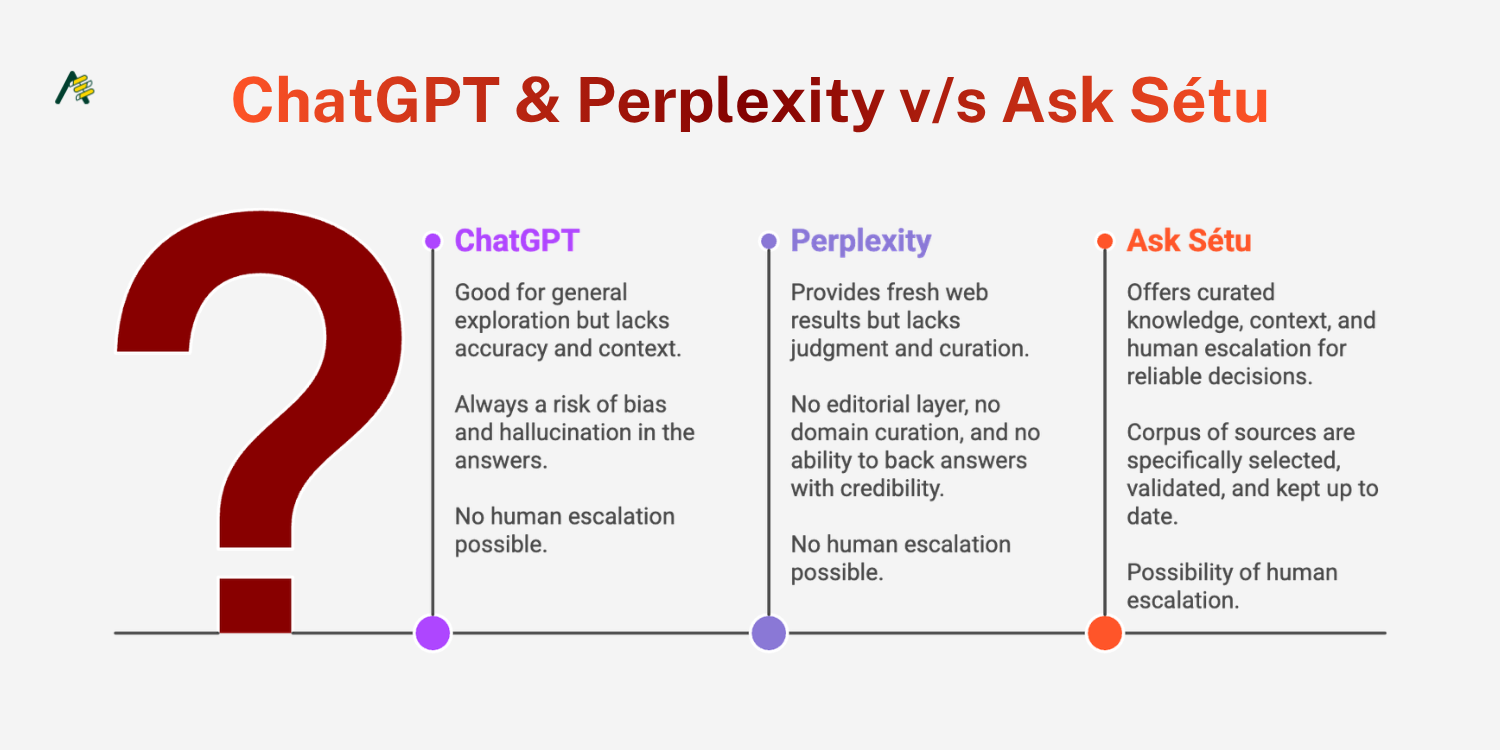
General-purpose LLMs are broad by design - and that breadth is the problem. ChatGPT and similar tools are trained on enormous amounts of internet text, which means they know a little about everything but can err when asked something particular. Ask about the language requirement in French schools, and you may get a confident answer that was accurate in 2022 but has since been updated. Ask about CAF eligibility for a student on a specific visa type, and the model will often generate a plausible-sounding response with no grounding in current policy. There is no mechanism to know when the answer is right and when it is dangerously out of date.
Perplexity adds web search, but not judgment. Perplexity and similar retrieval-augmented tools go a step further by pulling live web results, which solves the freshness problem partially. But they retrieve from the open web indiscriminately. A result from an outdated student forum carries the same weight as the official Campus France guidelines published last week. There is no editorial layer, no domain curation, and no ability to tell a student "this source is authoritative for your situation and this one is not."
Ask Sétu is built differently on three dimensions.
Curated, maintained knowledge, not the whole internet. The knowledge base underlying Ask Sétu is not a general web index. It is a corpus of sources specifically selected, validated, and kept current for the India-to-France student journey: official university portals, Campus France documentation, government administrative sites, and vetted guidance from practitioners. When Ask Sétu retrieves an answer, it is pulling from a carefully bounded and maintained domain, not performing a lottery across millions of web pages.
Context that accumulates across a journey. General-purpose chatbots start fresh with every conversation. They have no memory of who you are, where you are in the process, or what you asked last month. Ask Sétu is designed to hold context across the student's journey — knowing that someone who asked about MS in Computer Science options in September is now asking about CAF applications in November means the responses can be genuinely personalised, not just generically accurate.
Human escalation when it matters most. ChatGPT cannot refer you to an expert when a question exceeds its reliable knowledge. Ask Sétu can, and does. When a query touches on legal status, complex financial situations, or anything where a wrong answer has serious consequences, the platform routes to a human expert with the full conversation context already in hand. That backstop changes the nature of the trust a student can place in the system.
The honest framing is this: general-purpose AI is a remarkable tool for exploration. Ask Sétu is built for decisions — and for students whose futures depend on getting those decisions right.
Why This Approach Worked
Most tools in this space make one of two mistakes: they try to do everything with AI and end up unreliable on the specifics, or they rely entirely on humans and end up unscalable and prohibitively expensive. Ask Sétu avoided both traps through three structural decisions.
Depth over breadth. Rather than building a general immigration assistant or a catch-all study-abroad tool, Ask Sétu went deep on a single corridor - India to France. That specificity allowed the team to build a knowledge base that is genuinely authoritative, not a surface-level summary of publicly available information. Students feel the difference immediately.
Lifecycle thinking. The five-stage framework reflects how students actually experience their journey, not how administrators categorise support services. This meant the product could be useful at every phase rather than excellent in one area and absent in others.
The hybrid model as a feature, not a fallback. Other platforms treat human experts as an emergency escalation, something you reach only when the AI breaks down. Ask Sétu positioned human expertise as a natural, expected part of the experience. This dramatically increases trust. Students know they are not alone with an AI when the stakes are high.
Key Lessons From This Project
Knowledge freshness is a product problem, not a technical one. Web crawling solves the data layer, but deciding what to ingest, how to validate it, and when to deprecate outdated content requires editorial judgment. Maintaining a high-quality knowledge base is a continuous editorial operation, not a one-time engineering task. This commitment is, in practice, a meaningful competitive moat.
Users will stress-test you with their most anxious questions first. The first thing many students ask is their most pressing, most emotionally loaded question, not a warm-up query. The product had to perform at its best under pressure, not just with comfortable, well-formed inputs. This shaped how the AI was prompted and how uncertainty was communicated to users.
The handoff to a human is a product moment, not a failure state. Early versions treated expert escalation as friction to minimise. The team found the opposite: a well-designed handoff that preserves context and sets clear expectations actually increased user satisfaction. Students felt safer knowing a human was reachable. The escalation became a feature to polish, not a failure to hide.
Specificity of audience compounds over time. Building for Indian students in France — rather than all international students everywhere — created a natural word-of-mouth engine within a tight, trust-based community. Indian students in France know each other, refer each other, and recruit within their networks. Depth of fit for a focused audience scales differently, and more durably, than breadth of fit for a large one.
The AI is only as trustworthy as the process behind it. Users cannot see the vector database or the crawling pipeline. What they experience is the answer. Communicating sources, confidence levels, and limitations "based on current information from Campus France as of this year" dramatically increases perceived trustworthiness even when actual accuracy is unchanged. Transparency is a UX lever, not just an ethical one.
Conclusion
The problem Ask Sétu is solving is not primarily a technology problem. It is a trust problem.
Students moving to France are making one of the biggest decisions of their lives in an environment of high uncertainty, high stakes, and low familiarity. They need to feel guided, not just informed. The difference between those two things is enormous — and it is precisely the gap that Ask Sétu was built to close.
By pairing AI's availability and breadth with human expertise's depth and judgment, Ask Sétu has built something that neither alone could be: a companion for the entire journey. Not a search engine. Not a consultant. Something in between, available at midnight, reliably current, personal in its responses, and connected to a community of people who have made the same journey before.
The ambition is straightforward: make France feel navigable for every Indian student who chooses it. And in doing so, make the choice itself - and the experience that follows - one they would make again.
Explore Ask Sétu at asksetu.com
Adaptiv Admin
@admin
Building the future of AI products at Adaptiv.Me.
More Articles
Case Study: How Magic Was Built to Make Paris Feel Smaller
Case Study: How Lama Was Built to Close the Gap Between Business Data and Business Decisions
Case Study: How Globist Is Building the AI Workspace To Kill the Marketing Tab Spiral
Case Study: How Paays built a one-of-a-kind travel lending experience