Case Study: How Magic Was Built to Make Paris Feel Smaller
Adaptiv Admin
Mar 31, 2026 · 9 min read
Executive Summary
Paris is one of the most culturally rich cities in the world - but that richness comes with a paradox. There is always too much happening, spread across too many sources, for any one person to navigate. Concerts, pop-ups, gallery openings, restaurant launches, underground parties: the signal drowns in noise.
Magic is an AI-powered personal assistant designed for Paris residents who want to stay connected to the cultural pulse of their city without the exhausting effort of tracking it themselves. It learns your tastes, monitors events across dozens of sources, surfaces what matters to you, and sends timely reminders so you never have to say "I didn't know about that" again.
The Challenge
For Paris residents, cultural FOMO is structural, not personal. The city generates an extraordinary volume of events every week: concerts across twenty arrondissements, chef pop-ups that sell out in hours, art installations with no digital footprint, seasonal markets, rooftop parties, and film screenings announced just days in advance.
The challenge is not access to information - it's that there is far too much of it, scattered across incompatible channels. Aggregator sites like Paris Secrets and Timeout Paris list everything for everyone, which means they're useful for no one in particular. Social media and influencers surface interesting events but don't help you track them — a post you liked three weeks ago is gone from your feed. Word of mouth remains the dominant discovery mechanism, which means your cultural life is bounded by your social circle's tastes, not your own.
"I always find out about events the day after. I follow the right accounts, I check the right sites — but there's just no system that puts it all together for me."
The result is predictable: most Paris residents default to doing nothing, or scramble at the last minute. Not because they don't care about the city around them - but because the coordination cost of staying informed is simply too high.
Why Existing Solutions Aren't Enough
Every partial solution to this problem shares a common flaw: it optimizes for breadth of content rather than depth of personalization. Existing tools ask users to come to them, rather than meeting users where their interests actually live.
Event aggregators are directories, not assistants. They require users to actively search, filter, and re-check multiple times per week, with no memory of what you've engaged with before. Newsletter subscriptions add to inbox noise and arrive on the publisher's schedule, not yours — with no interactivity and no personalization beyond the list you subscribed to. General-purpose AI tools like ChatGPT can answer questions about Paris events, but they have no real-time data, no persistent preferences, and no proactive notification system. And social media surfaces events algorithmically, optimized for engagement rather than your genuine interests.
The gap
No tool combines real-time event intelligence, deep personal preference modelling, proactive alerting, and conversational interaction in one place. That is exactly the gap Magic was designed to fill.
The Solution
Magic is built around a simple premise: your city's cultural life should come to you, curated to your taste, before you even think to look for it.
At its core, Magic is a conversational AI assistant paired with a powerful event intelligence engine. Users tell Magic what they care about, or Magic infers it from their behaviour - and the assistant does the rest: monitoring, matching, saving, and reminding. Users can set up interest profiles covering music artists, cuisines, neighborhoods, and event types. They can ask in plain language: "Notify me when The Weeknd announces a Paris date" or "Find me a jazz bar in the 11th this Saturday." Magic understands and acts.
Using vector search, Magic also surfaces events that are similar in feel to what you've liked before — not just exact matches. If you loved a rooftop electronic music night, Magic finds the next one before you know it exists. Content from across the web can be saved and automatically categorized. And proactive reminders go out before events sell out, before they happen, and when similar events are announced — the assistant doesn't wait for you to check in.
Product Design
The design philosophy behind Magic was deliberately conversational and low-friction. The product's value proposition would fail if users had to invest significant effort to get started, so every design decision was made to reduce the time between download and first moment of delight.
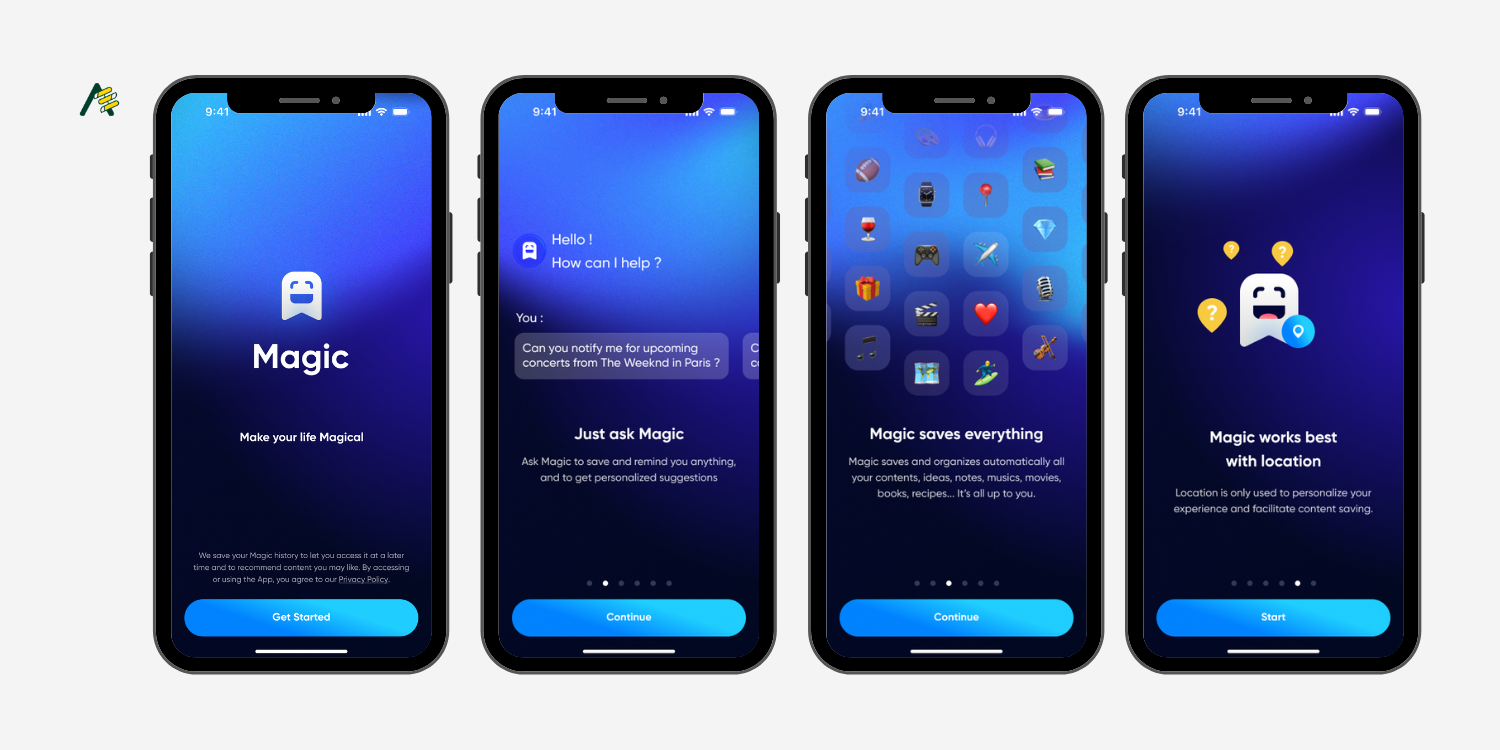
The onboarding flow introduces the product's three pillars in sequence. The first screen opens with a conversation: "Hello! How can I help?" — with an example prompt showing a user asking for notifications about The Weeknd in Paris. The second screen establishes Magic's memory layer: a visual grid of interest categories the assistant uses to build a taste profile automatically. The third introduces location, used to make suggestions hyper-relevant to the user's neighborhood, not just the city at large.
The ghost mascot (friendly, slightly mysterious) communicates playfulness while hinting at Magic's behind-the-scenes intelligence. It appears throughout onboarding and idle states, reinforcing the idea that Magic is always watching out for you, even when you're not actively using the app. The dark, gradient-rich visual language — deep navy to electric blue — evokes a night out in the city, deliberately contrasting with the utilitarian aesthetic of productivity apps to signal that Magic lives in the world of culture and experience.
Design principle
Every screen in onboarding answers one question: "What will Magic do for me right now?" The product earns trust incrementally - one capability at a time - before asking for permissions or investment from the user.
Technology
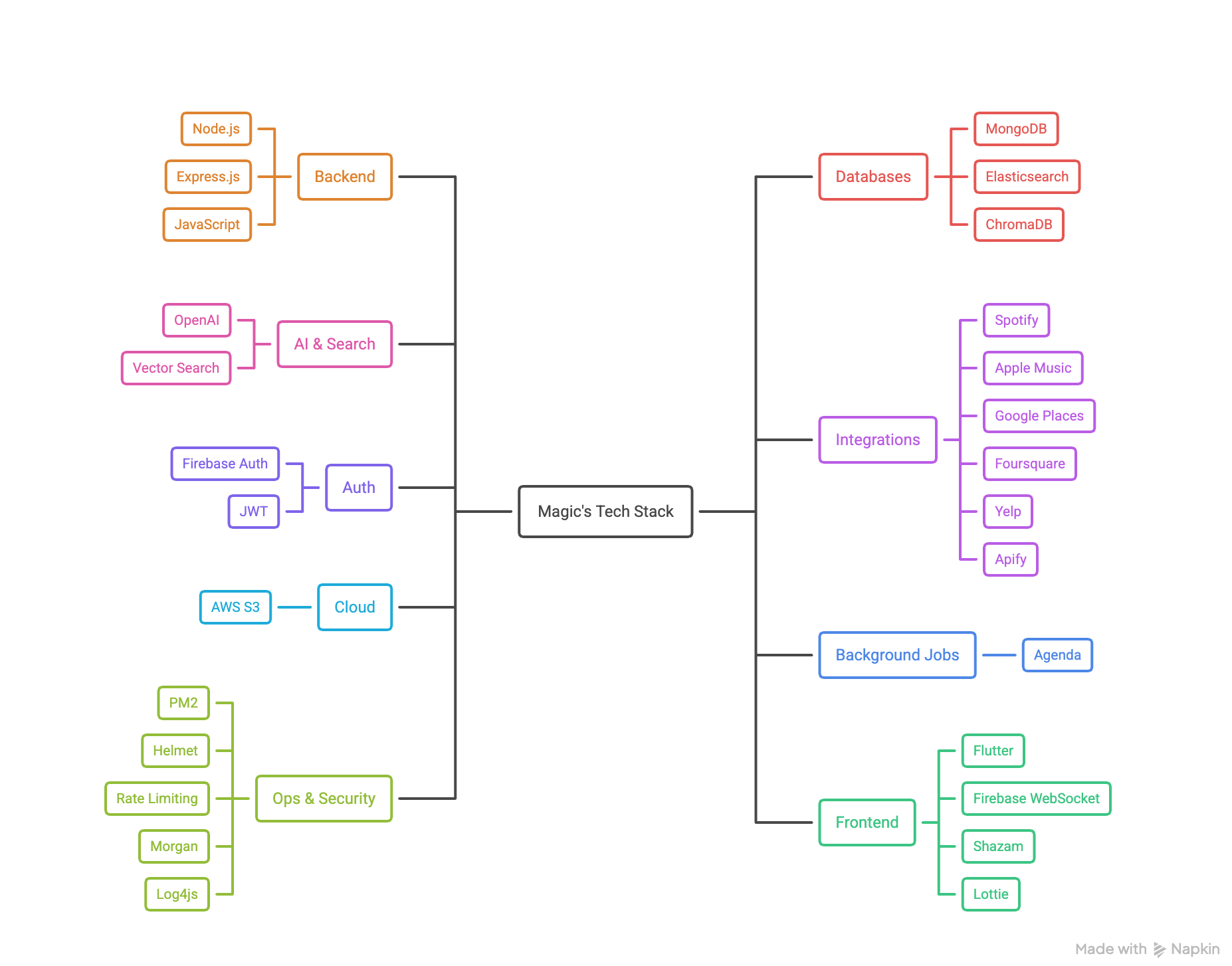
Magic's stack was chosen to support three simultaneous requirements: ingesting data from a large and heterogeneous set of sources, performing semantic search and personalisation at scale, and delivering a real-time conversational experience on mobile.
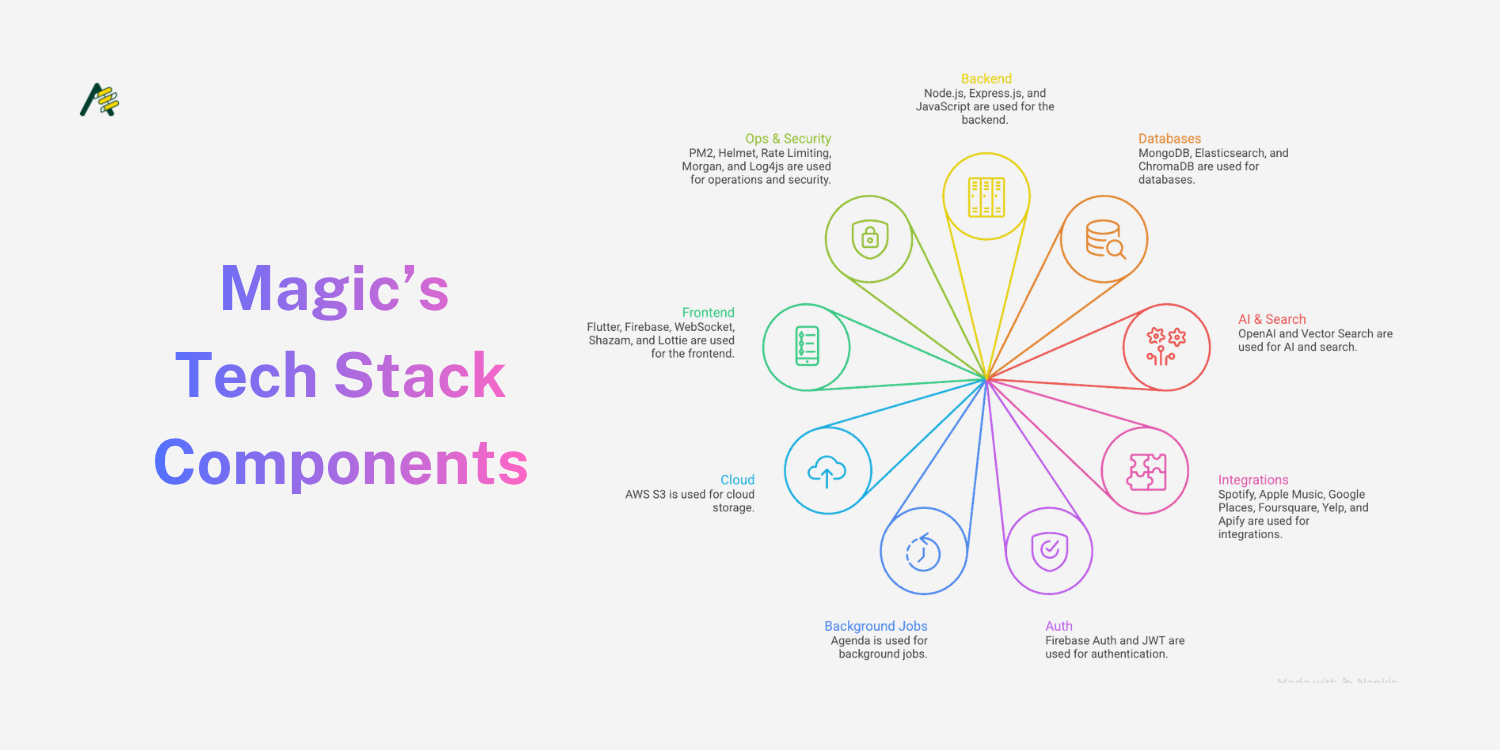
The most consequential architectural decision was a dual-search layer. Elasticsearch handles structured queries like "jazz concerts in the 10th arrondissement this Friday." ChromaDB, a vector database, handles semantic search, finding events similar in feel and context to things a user has previously engaged with, even when there's no obvious keyword match. Together they meet users wherever they are in their discovery journey.
On the data sourcing side, structured APIs - Spotify, Apple Music, Google Places, Foursquare, Yelp - cover the formal layer of Parisian cultural life. But much of what makes Paris interesting never appears in structured databases. It lives in Instagram Stories, TikToks, and tweets. Apify-powered scrapers across YouTube, TikTok, Instagram, Twitter, and LinkedIn capture this informal layer — and it's consistently where Magic surfaces recommendations users couldn't find anywhere else.
Why This Approach Works
Looking back, Magic's approach succeeded because it made three key bets that set it apart from everything that came before.
Conversation over configuration. Rather than asking users to set up complex filters, Magic lets them express what they want in natural language. This mirrors how people actually think about their cultural interests — fluidly, contextually, and often in the moment — and eliminates the cognitive tax of structured onboarding entirely.
Proactive over reactive. Most discovery tools wait for users to come looking. Magic inverts this model: the assistant works in the background, monitors the landscape on your behalf, and reaches out when something relevant appears. This transforms the user's relationship with the product from a tool they consult to an assistant they trust.
Wide data sourcing, narrow presentation. Magic ingests from a deliberately wide set of sources and then narrows aggressively to what is relevant to each individual user. The richness is in the backend; the simplicity is in the interface. Users never see the complexity behind their recommendations - they just see the right thing at the right time.
Key Lessons From This Project
Design for schema flexibility early. The interconnected nature of users, artists, events, venues, and saved content required a NoSQL-first approach. MongoDB's document model gave the team the flexibility to evolve data structures without costly migrations as the product changed rapidly.
Third-party APIs will fail — plan for it. With over a dozen external integrations, the probability of at least one dependency being unavailable at any given moment approaches certainty. Graceful degradation patterns and circuit breakers across all integrations ensured external failures never surfaced as user-facing errors.
Auth consistency is non-negotiable. With Firebase Auth and JWT operating across multiple modules, enforcing a single authentication pattern across all endpoints early in development prevented the security vulnerabilities and unpredictable sessions that inconsistent auth handling typically produces.
Visible intelligence builds trust. AI personalization only creates value if users can see it working. Surfacing explanation text alongside recommendations — "We found this because you saved a jazz event last month" — made the assistant's intelligence legible and gave users a reason to engage more deeply over time.
Background jobs are a product feature. The reminder and monitoring system powered by Agenda was treated as a core product commitment, not a backend utility. Its reliability directly determined whether users trusted Magic enough to depend on it — which meant engineering investment here had to match its product importance.
The informal data layer is where real value lives. The events that make Paris special are disproportionately the ones that never appear in structured databases. Building the scraping infrastructure to capture social content wasn't a nice-to-have — it was what differentiated Magic's recommendations from every other tool on the market.
Conclusion
Magic was built on the belief that every resident of Paris deserves a city that feels curated for them, not overwhelming, not scattered, but alive and personal. By combining conversational AI, real-time event intelligence, and proactive reminders into a single experience, it transforms the city's cultural chaos into something navigable, delightful, and genuinely yours.
The tools to build this kind of product exist today. What takes craft is knowing how to combine them in a way that feels effortless to the person on the other end, and that's what this project was really about.
Magic has not yet launched. Following early testing, the team identified market-fit challenges that required a rethink of the product's direction. Magic is currently going through a pivot.
Adaptiv Admin
@admin
Building the future of AI products at Adaptiv.Me.
More Articles
Case Study: How Lama Was Built to Close the Gap Between Business Data and Business Decisions
Case Study: How Globist Is Building the AI Workspace To Kill the Marketing Tab Spiral
Case Study: How Ask Sétu Was Built to Guide Indian Students Through Every Stage of Life in France
Case Study: How Paays built a one-of-a-kind travel lending experience