Case Study: How Globist Is Building the AI Workspace To Kill the Marketing Tab Spiral
Adaptiv Admin
Mar 30, 2026 · 12 min read
Executive Summary
Globist is a unified, AI-powered workspace for marketing and GTM teams. It replaces the fragmented stack of research tools, writing assistants, design platforms, and scheduling apps with a single, spatial canvas where every step of the campaign workflow, from market research and competitive analysis to visual creation, video scripting, and publishing, happens in one place, with shared context across every node.
The product is built on a model-agnostic AI architecture drawing on OpenAI, Anthropic's Claude, SERP, Reddit, Arxiv, YouTube, and Perplexity APIs, orchestrated through a React.js canvas interface. The result is a system that doesn't just speed up individual tasks but restructures the entire workflow - compressing campaign cycles from days to hours and making the institutional knowledge behind every deliverable visible, persistent, and collaborative.
The Challenge
Walk through the workflow of a single GTM deliverable - say, a competitive positioning deck for a product launch. It starts with market research: scanning search results, reading Reddit threads for real customer sentiment, pulling academic or analyst sources. That research needs to become a brief. The brief needs to become a script. The script needs to become a visual, or a video, or a post. The post needs to go out, and performance data needs to come back in.
Every one of those steps currently lives in a different product. Not just different tabs - different interfaces, different pricing plans, different AI models with different memories, and none of them talking to each other.
The consequences are concrete and measurable, but research done in one tool doesn't follow you to the next. When you open your design platform, it has no idea what your research said. When you open your AI writing tool, it has no idea what your design direction is. Context is rebuilt from scratch at every handoff, and the cognitive overhead accumulates silently across every cycle.
For marketing professionals specifically, this is especially damaging. Their work is inherently multi-modal - it spans text, image, video, and data - and inherently team-based. A workflow that works for a solo user in a single session breaks down the moment a second person joins or the campaign runs beyond a single sitting.
The problem isn't that any individual tool is bad. The problem is that the workflow was never designed as a system.
Why Existing Solutions Aren't Enough
The market has responded to tool fragmentation in two predictable ways, and neither works.
The first response was integration layers: Zapier, native webhooks, and API connectors that pass data between siloed platforms. These reduce manual copying but don't solve the core problem - the tools still have no shared understanding of what the team is trying to accomplish. A Zap that pastes research results into Notion doesn't give your design tool any awareness of what that research said.
The second response was AI copilots bolted onto existing products: Notion AI, Canva's generative features, ChatGPT plugins for specific platforms. These are meaningfully useful within their host product, but they inherit all of that product's constraints. Notion AI knows what's in your document. It has no idea what your competitor research said or what creative direction your designer chose.
General-purpose large language models (ChatGPT, Claude, Gemini) are a different category of partial solution. They are exceptional reasoning engines, capable of research synthesis, long-form writing, strategic analysis, and creative ideation. But they are fundamentally conversation-shaped. They work best with a question, a response, a follow-up. That shape doesn't map onto a GTM workflow, which is non-linear, multi-modal, team-based, and needs to produce artefacts - documents, images, videos, posts - that live outside the chat thread.
Most critically: every new conversation starts from zero. There is no persistent canvas. There is no shared memory between teammates. There is no path from a research thread to a finished creative asset without rebuilding context from scratch at every step. LLMs are a powerful component. They are not a system.
The Solution
Globist is built around a spatial, node-based canvas. It's a concept borrowed from tools like Figma and Miro, but reimagined from scratch for AI-native, multi-modal workflows. Every piece of work lives as a node on the canvas: a research query, a competitive insight, a brief, a script, an image, a video, a published post. Nodes connect to each other, branch, and build on each other, creating a visible map of how ideas evolve into deliverables.
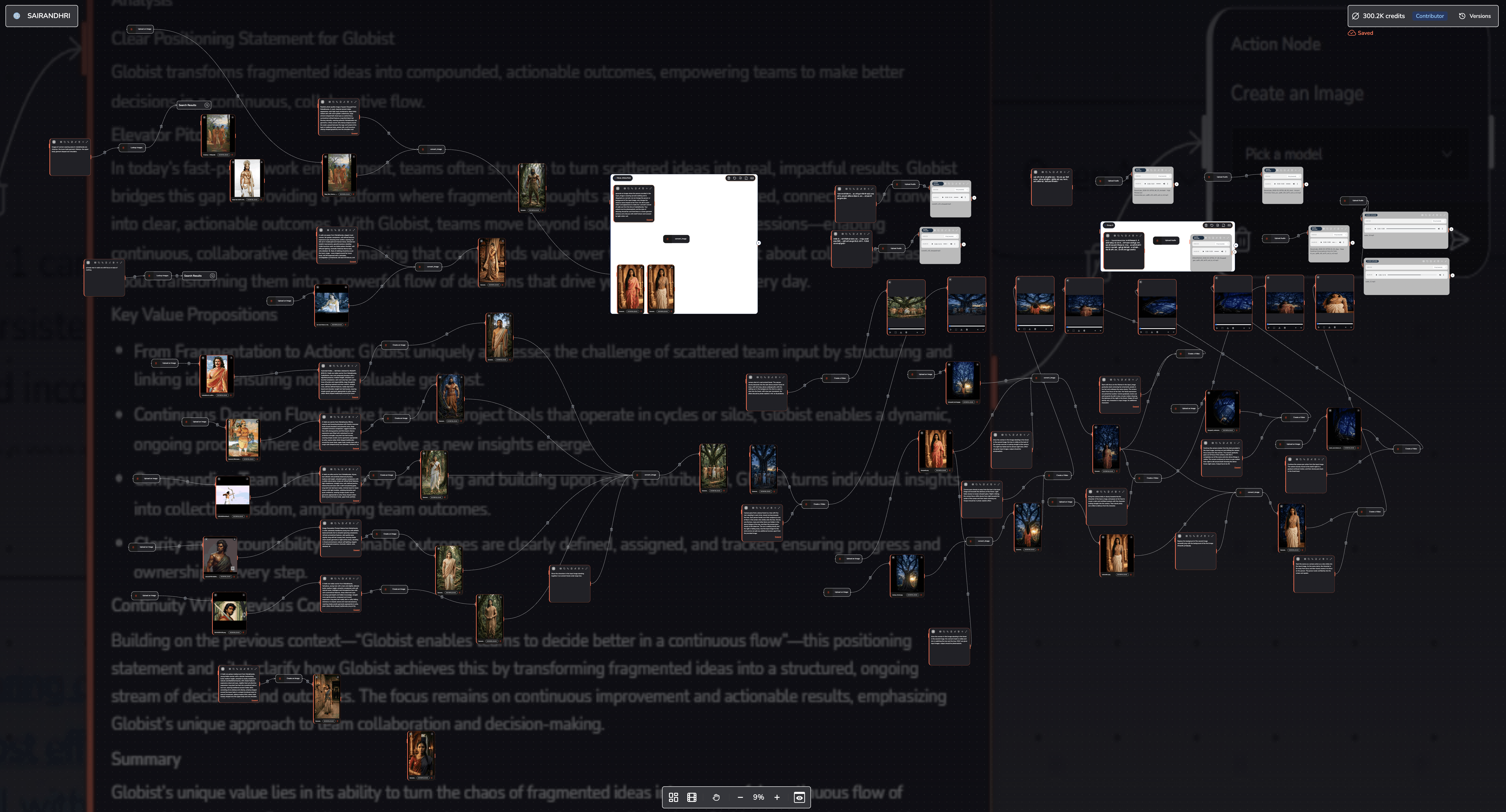
The canvas has persistent context. When a user pulls live data from Reddit about a competitor, that context is available to every subsequent creative node in the same workspace. When a video script is drafted, it already knows what the research found. When a visual is generated, it inherits the tone and direction from the brief. Every step forward accumulates value rather than discarding it.
Product Design
The design philosophy behind Globist is rooted in a single principle: reduce decisions, not just clicks. Most productivity tools optimise for speed at the task level — they make individual actions faster while leaving the cognitive burden of deciding what to do next entirely on the user. Globist removes that burden by surfacing the right next step at each node. When a research pull completes, the canvas suggests the logical continuation. When a script is approved, the visual generation node is pre-configured with the relevant context already loaded.
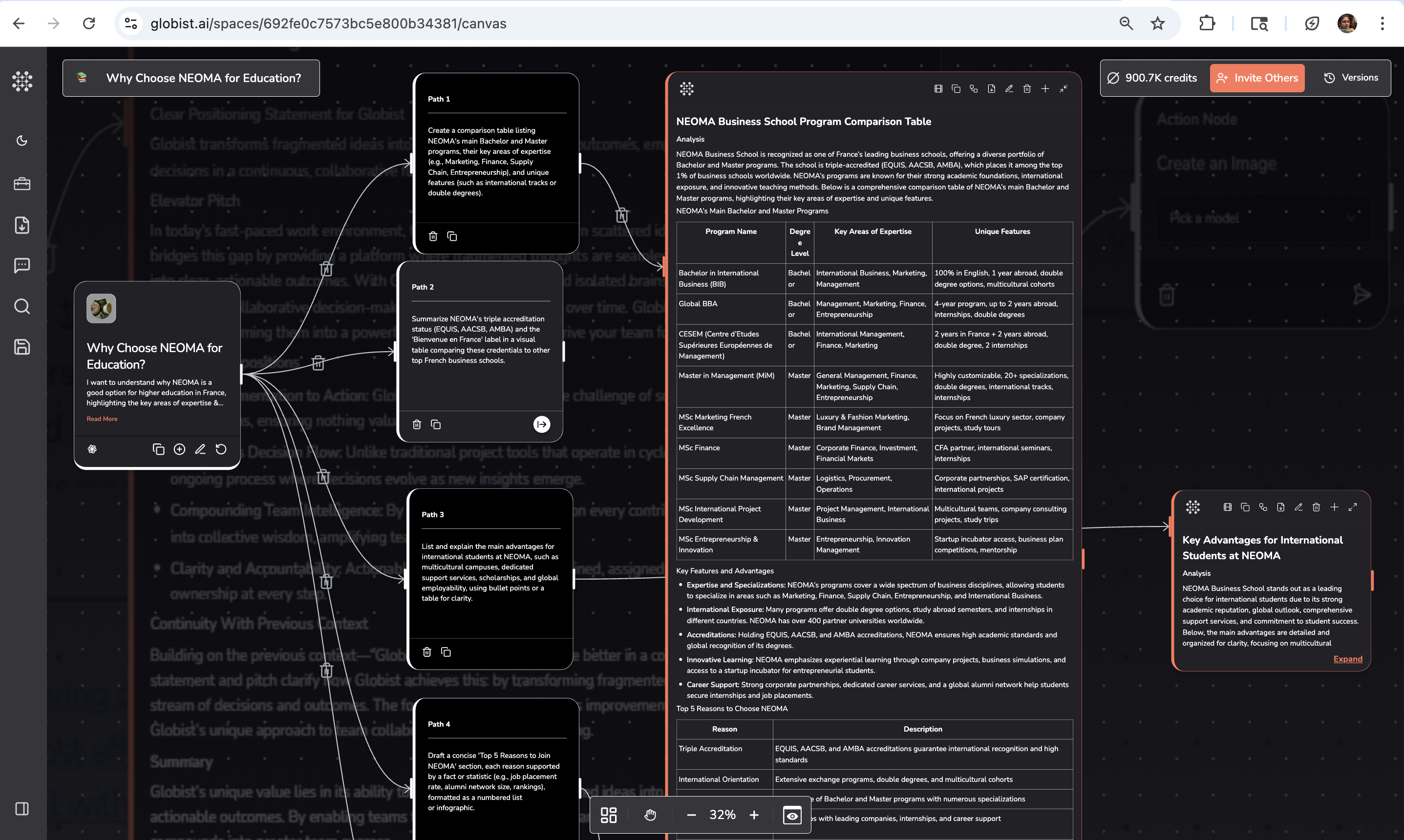
The spatial canvas interface is a deliberate choice, not an aesthetic one. Unlike a linear chat thread or a paginated document, the canvas allows teams to see the full shape of a project at once — where research ends and creative begins, which strategic branches were explored and which were discarded, how a finished deliverable traces back to the original insight that sparked it. This spatial awareness dramatically reduces the overhead of project management without adding a single additional tool to the stack.
Collaboration is first-class. The canvas is shared, versioned, and built for simultaneous contribution. When a new team member opens a workspace, they see the full history of decisions and reasoning behind every deliverable — not a chat log, but a structured visual map of how the work evolved. This turns the canvas into an institutional memory, not just a productivity tool.
How It's Different from ChatGPT, Claude, and Gemini
Globist is not a chat interface and was not designed to compete with general-purpose LLMs. The distinction matters because the category confusion is real: teams often try to solve the workflow fragmentation problem by routing everything through a single AI assistant. It doesn't work, for four structural reasons:
Chat interfaces have no persistent canvas. Every session starts from zero, and the history of a conversation is not the same thing as a structured, navigable workspace.
General-purpose LLMs are trained on a knowledge cutoff - Globist connects to live data sources in real time, meaning research is grounded in what Reddit is actually saying today, what search results are actually returning today, and what the academic literature most recently published.
LLMs are single-user, single-session tools by design. Globist's canvas is shared and persistent across a team.
LLMs primarily poduce text. Globist produces finished multi-modal deliverables - documents, images, video scripts, and scheduled posts - from a single unified session.
The relationship between Globist and models like Claude and GPT-4 is one of composition, not competition: Globist uses these models as reasoning engines within a workflow architecture designed specifically for marketing teams.
Technology
The technology stack behind Globist reflects a clear philosophy: use the best model for each task, connected by a coherent architecture, rather than defaulting to a single provider for everything.
OpenAI provides the core reasoning and generation layer for rapid ideation, structured content output, and fast creative drafting.
Anthropic's Claude handles long-form synthesis, nuanced brand analysis, and the deeper reasoning tasks that benefit from Claude's extended context and careful handling of ambiguous instructions.
Claude Code powers the more agentic execution tasks - sequential, multi-step workflows that need to run without human prompting at each stage.
The research layer draws on four live data sources simultaneously.
SERP API provides current search results, giving teams a real-time view of how a topic is being indexed and what competitive content looks like.
Reddit API surfaces genuine community sentiment — what real customers and users are actually saying about a product, a competitor, or a category.
Arxiv API connects teams to academic and technical literature, useful for industries where research-backed claims matter.
YouTube API brings video research into the canvas, allowing teams to analyse content trends, competitive creative, and audience engagement patterns.
Perplexity API adds a layer of AI-augmented search synthesis, combining the speed of retrieval with the coherence of generated summaries.
The canvas itself is built in React.js, enabling the dynamic, node-based interface that allows users to branch, connect, and navigate their work spatially.
React's component model maps naturally onto the node architecture of the canvas — each node is a discrete, stateful component, and the connections between nodes are first-class data rather than an afterthought.
The model-agnostic routing is a deliberate architectural choice with a strategic rationale. It prevents vendor lock-in at a moment when the AI provider landscape is changing faster than any SaaS product cycle. It allows the team to swap or upgrade individual components — a new OpenAI model, a new Claude release - without rebuilding the product around them. And it ensures that the best model for each specific task is always the one being used, not the most convenient one.
Why This Approach Works
The reason Globist's approach is differentiated isn't simply the feature set. It's the compounding nature of a shared, persistent workspace.
Each piece of work done on the canvas makes the next piece easier. Research nodes inform creative nodes. Creative nodes build on each other. Over time, the canvas becomes a record of how a team thinks - not just a place where deliverables are stored, but a living map of institutional intelligence. This creates what might be called workflow gravity: the longer a team uses a Globist canvas, the more valuable it becomes relative to starting elsewhere. Unlike a chat interface that resets with every session, the canvas retains context indefinitely.
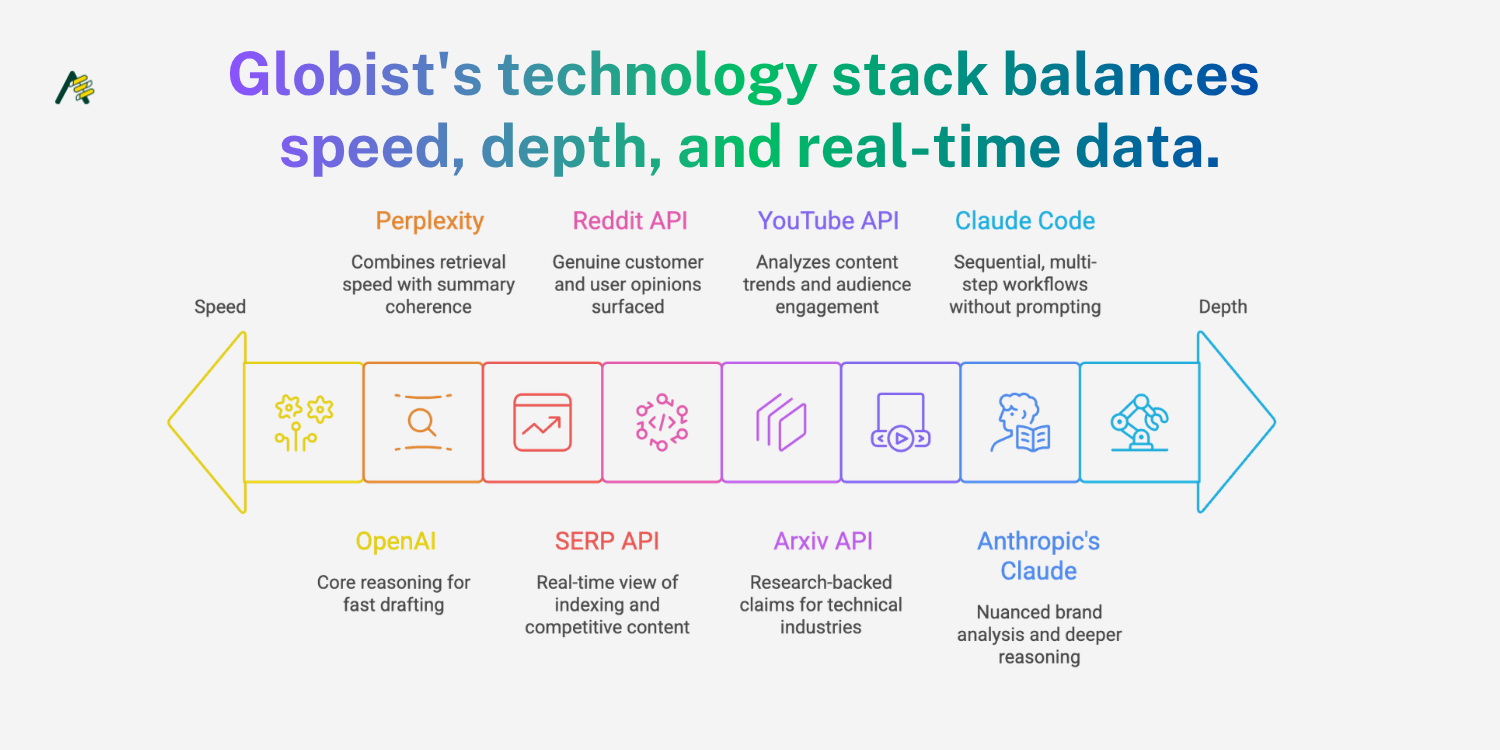
The multi-source research layer matters in ways that go beyond convenience, too. When a GTM team researches a market using a single data source, they inherit that source's blind spots and biases. By pulling simultaneously from search results, community forums, academic literature, and video platforms, Globist surfaces a genuinely richer picture of any topic - and one that is visibly multi-sourced, which carries weight in client-facing documents and executive pitches where research credibility matters.
The spatial interface also changes how teams approach strategic problems. The ability to see an entire project — its research foundations, its creative branches, its discarded directions, its finished outputs — in a single view enables a quality of strategic thinking that linear tools don't support. Teams stop thinking in sequential steps and start thinking in connected systems.
Key Lessons From This Project
The unit of productivity isn't the task - it's the workflow. Making individual tasks faster delivers limited ROI if the surrounding workflow is still broken. The highest-leverage intervention is redesigning the system, not accelerating steps within a broken one.
Spatial interfaces unlock team thinking that linear ones don't. Early prototypes used a document-based layout. Switching to a spatial canvas wasn't just an aesthetic decision - it changed how teams approached problems. Seeing the full shape of a project simultaneously enabled a different quality of strategic thinking.
Model-agnostic routing is a product moat, not just a technical detail. Defaulting to a single AI provider is tempting for simplicity. But routing tasks to the right model for each job produces measurably better outputs - and creates a differentiation that single-provider products can't easily replicate.
Live data changes the nature of the output. Research grounded in real-time Reddit sentiment, current search results, and recent YouTube trends produces fundamentally different, and more defensible, outputs than research generated from an LLM's training data alone. Users notice the difference immediately and it shows in the quality of client deliverables.
The collaboration layer is the retention layer. Individual users adopt the product for productivity. But teams that adopt Globist together develop shared canvases that accumulate institutional value - making churn dramatically less likely because leaving means losing the living memory of the workspace.
Design for the outcome, not the feature. Every product decision was evaluated against a single question: does this get a team closer to a finished, publishable deliverable faster? Features that were technically impressive but didn't move the campaign cycle forward were cut, regardless of their sophistication.
Conclusion
The fragmentation of the modern marketing stack isn't a temporary inconvenience waiting to be solved by a better plugin. It is a structural problem - and one that emerged because tools were built in isolation and connected only as an afterthought.
Globist makes a different bet: that the right starting point is the workflow itself, and that every AI capability should be assembled around that workflow from the beginning rather than bolted onto it later. The canvas paradigm, combined with persistent context, live multi-source research, and a model-agnostic AI layer, creates a system that becomes more valuable with every use.
For GTM teams who currently spend their days moving between tabs, losing context, and rebuilding briefs from scratch, Globist represents something genuinely new - not an improvement on the old model, but a replacement for it.
The teams that win the next era of marketing won't be the ones with access to the most AI tools. They'll be the ones who figured out how to make those tools work as a single, coherent system.
Explore Globist at globist.ai
Adaptiv Admin
@admin
Building the future of AI products at Adaptiv.Me.
More Articles
Case Study: How Magic Was Built to Make Paris Feel Smaller
Case Study: How Lama Was Built to Close the Gap Between Business Data and Business Decisions
Case Study: How Ask Sétu Was Built to Guide Indian Students Through Every Stage of Life in France
Case Study: How Paays built a one-of-a-kind travel lending experience